

You're spending money every day. The clicks are coming in. The dashboard shows "impressions" and "CTR" climbing. And yet your phone isn't ringing and your inbox is quiet.
If that's where you are right now, take a breath because the problem usually isn't your budget, and it almost never means Google Ads "doesn't work for your business." We've audited enough accounts to tell you the uncomfortable truth: most campaigns leak leads at predictable, fixable points. You just can't see them from inside the Google Ads dashboard.
This article walks through exactly why your Google Ads campaign is not generating leads, in the order these problems actually do damage and how to fix each one.
Introduction: Google Ads Is Not "Plug and Play"
Most businesses treat Google Ads like a vending machine. Put money in, get leads out. Pick some keywords, write an ad, set a budget, and wait for the enquiries to roll in.
Then they don't.
Here's the reality: Google Ads only performs when three things are aligned, strategy, tracking, and landing pages. Break any one of them and the whole machine stalls, no matter how much you spend. You can have brilliant keywords pointing at a weak landing page and get nothing. You can have a great landing page with broken tracking and never know what's working.
The platform isn't broken. The structure around it usually is. By the end of this guide, you'll be able to point at the exact stage where your leads are disappearing, and you'll know what fixing it looks like.
The Real Google Ads Funnel (The Foundation Most People Skip)
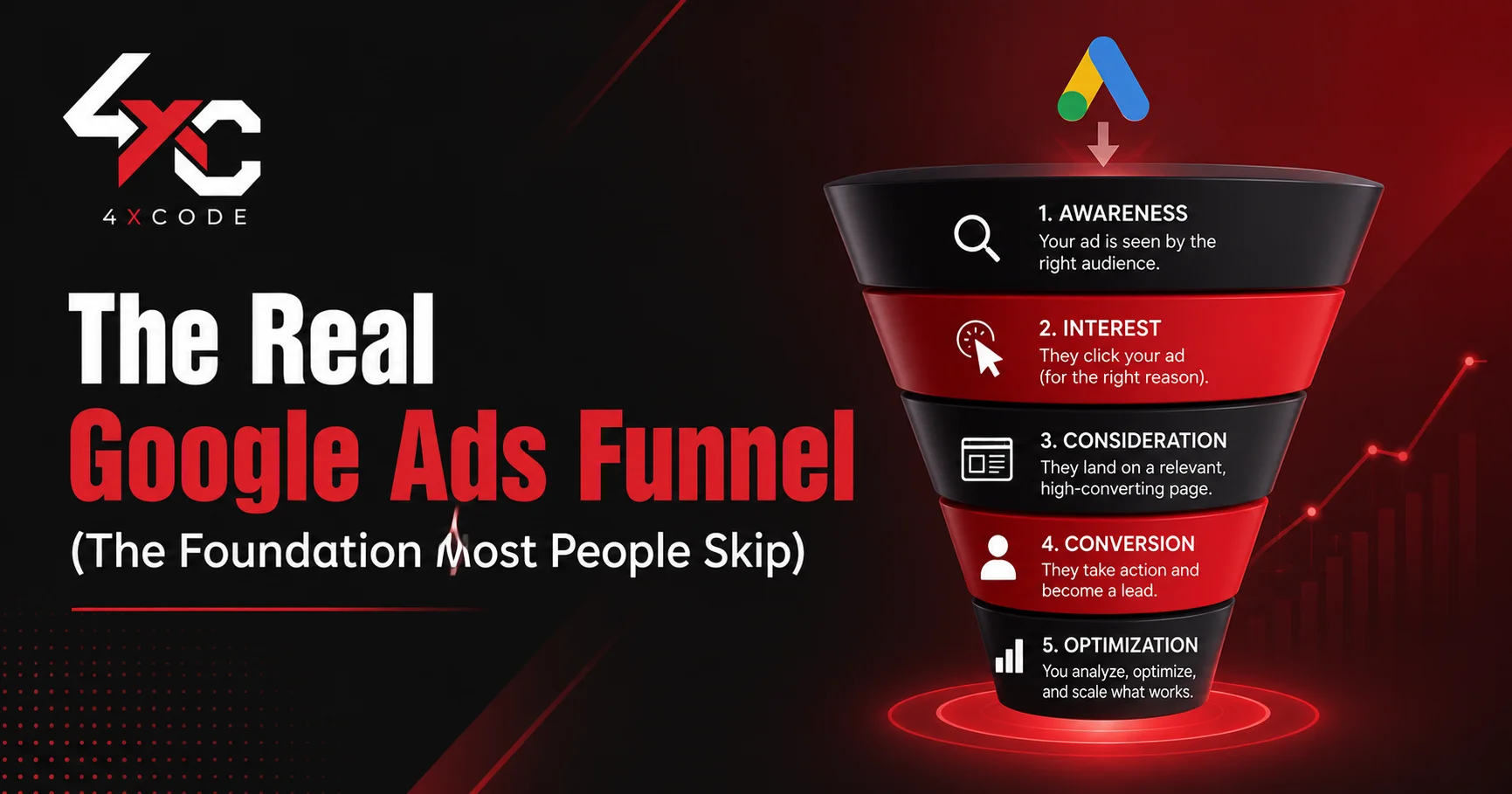
Before we get to the six reasons, you need this mental model. A lead doesn't come from "an ad." It survives a five-stage gauntlet, and a failure at any stage kills it. Most accounts obsess over the first stage and ignore the rest.
Here's the journey every potential lead actually takes:
Stage 1 Search Intent. Someone types a query. But not all searchers are buyers. "How to fix a leaking tap" is a researcher. "Emergency plumber near me" is a buyer with a wallet open. If your ads chase the first group, you pay for traffic that was never going to convert.
Stage 2 The Ad Click. This is where most people fixate on click-through rate (CTR). But a high CTR is misleading on its own, it tells you the ad was interesting, not that the click was qualified. A clickbait-style ad can have a fantastic CTR and bring you nothing but tyre-kickers.
Stage 3 The Landing Page. This is where roughly 80% of campaigns quietly die. The click lands, the visitor glances, and within a few seconds decides to leave. No budget reaches the conversion stage if the page doesn't hold them.
Stage 4 The Conversion. Even an interested visitor bounces if your form is a wall of fields or your "call now" button is buried below the fold on mobile. Friction kills intent.
Stage 5 Tracking. This isn't part of the visitor's journey, but it's part of yours. Without proper tracking, you're making budget decisions blind, pouring money into the campaigns that feel right instead of the ones that actually produce leads.
Keep this funnel in mind. Every reason below maps to a leak in one of these stages.
Reason #1: Wrong Keyword Targeting
If your keywords are wrong, nothing downstream can save the campaign. You'll attract the wrong people perfectly.
The three most common keyword mistakes we see:
- Broad keywords pulling in irrelevant traffic. Bidding on a wide term like "marketing" or "software" invites thousands of searches that have nothing to do with what you sell. Broad match without tight controls is a budget shredder.
- No buyer-intent keywords. There's a world of difference between "boiler repair cost" (someone researching, comparing, possibly DIY-curious) and "best boiler repair service near me" (someone ready to hire). If your keyword list is full of the former, you're paying to educate people, not to win clients.
- Missing long-tail keywords. Specific, longer phrases like "emergency commercial electrician Manchester" convert far better and often cost less, because the searcher knows exactly what they want. Many accounts ignore them entirely and overpay for broad, competitive head terms.
The fix is rarely "more keywords." It's the right keywords, built around genuine buying intent and structured into tight, relevant ad groups.
Reason #2: Weak or Generic Ad Copy
You can have perfect keywords and still get ignored. Your ad is competing on a crowded results page against four or five rivals saying almost the same thing. "Quality service. Free quote. Call today." sounds like everyone else, so it persuades no one.
Strong ad copy usually has these four ingredients, and weak copy is missing most of them:
- An emotional trigger. People act on frustration, fear, relief, or desire, not features. "Stop overpaying for slow IT support" lands harder than "We provide IT support."
- Urgency or a real offer. "Same-day appointments available" or "Free site survey this week" gives a reason to click now rather than later (which usually means never).
- Trust signals. Reviews, years in business, certifications, or guarantees lower the risk in the searcher's mind. "Rated 4.9 from 600+ reviews" does more work than another adjective.
- Competitor differentiation. If you never explain why you beat the alternative, the searcher picks on price or position. Comparison-style angles, what makes you the safer choice, quietly win clicks from rivals.
Generic copy gets generic results. Copy that speaks to a specific person with a specific problem is what turns an impression into a qualified click.
Reason #3: Landing Page Not Built for Conversions
This is the big one, the stage where most campaigns hemorrhage money. You did everything right to earn the click, then sent it somewhere that wasn't designed to convert.
The usual culprits:
- Sending traffic to your homepage. Your homepage is built to please everyone, which means it persuades no one in particular. A paid visitor who clicked an ad for "commercial roof repairs" should land on a page about commercial roof repairs, not a general "Welcome to our website" page where they have to hunt.
- No clear call to action. If a visitor has to think about what to do next, you've already lost them. One primary action, call, book, or fill the form, repeated clearly down the page.
- No trust elements. Testimonials, review badges, accreditations, recognisable logos, and short case studies reassure a stranger that you're legitimate. Their absence makes even a good offer feel risky.
- A slow or clunky mobile experience. Most paid clicks now come from phones. A page that loads slowly, has tap targets too small to hit, or forces pinch-zooming loses the visitor before they read a word.
A dedicated, fast, single-focus landing page routinely converts several times better than a homepage. If you fix only one thing in your whole account, make it this.
Reason #4: No Negative Keywords Strategy
Here's a leak you can't see unless you go looking: the searches you don't want, quietly draining your budget every single day.
Without a negative keywords list, your ads show up for queries that will never become customers. Classic budget-wasters include:
- "free" people who want it for nothing
- "jobs" / "careers" / "salary" job seekers, not buyers
- "DIY" / "how to" researchers who want to do it themselves
- "cheap" often bargain-hunters outside your market
Every click on one of those is money gone with zero chance of return. On a mismanaged account, this leakage can swallow 20–40% of the budget before it ever reaches a real prospect.
Building and continuously refining a negative keyword list is unglamorous, ongoing work and it's one of the fastest ways to recover wasted spend and lower your cost per lead.
Reason #5: Poor Conversion Tracking Setup
This is the silent killer, because it doesn't just cost you leads, it costs you the ability to know which decisions are right.
If your tracking is broken or incomplete, you're flying blind:
- Phone calls aren't tracked. For service businesses, calls are often the main conversion. If they aren't recorded against the campaign that drove them, Google's algorithm can't optimise toward them and you can't either.
- Form submissions aren't tracked properly. A misfiring tag means real leads don't register as conversions, so your best-performing campaign can look like a failure.
- No attribution clarity. You can't tell which keyword, ad, or campaign actually produced the enquiry, so you optimise on guesswork.
- Decisions made on incomplete data. You end up cutting campaigns that were quietly working and feeding ones that only looked good.
Google's automated bidding is only as smart as the data you feed it. Garbage in, wasted budget out. Clean, complete conversion tracking, calls and forms both is the foundation everything else stands on.
Reason #6: Wrong Bidding Strategy
Even with everything above fixed, the wrong bidding setup can quietly cap your results.
The common mistakes:
- Using "Maximise Clicks" when you want leads. Maximise Clicks chases the cheapest traffic, not the most valuable. It'll happily buy you a flood of low-intent visitors. If leads are the goal, your strategy should be built around conversions, not raw clicks.
- No target CPA optimisation. Without telling Google what a lead is worth to you, the system has no anchor to bid intelligently against.
- No patience for the learning phase. Automated strategies need a window and enough conversion data, to calibrate. Panicking and changing the strategy every few days resets that learning and keeps performance permanently unstable.
The right bidding strategy depends on your goals, your data volume, and your maturity in the account. But it must be a deliberate choice tied to leads, not a default left on since the campaign launched.
To make the contrast clear, here's how the wrong setup compares to the right one across the whole account:
Area | Why Campaigns Fail | What Actually Works |
| Keywords | Broad terms, research intent | Tight buyer-intent + long-tail keywords |
| Ad copy | Generic, no offer or trust | Emotional hook, offer, proof, differentiation |
| Landing page | Homepage, weak CTA, slow on mobile | Dedicated page, one clear CTA, fast, trust-rich |
| Negative keywords | None budget leaks daily | Actively maintained exclusion list |
| Tracking | Calls/forms untracked, no attribution | Full call + form tracking, clear attribution |
| Bidding | Max Clicks, no CPA, no patience | Conversion-focused, CPA-guided, allowed to learn |
Notice the pattern: every failure is structural, not a flaw in the platform.
How We Fix These Problems: The 4xcode Process
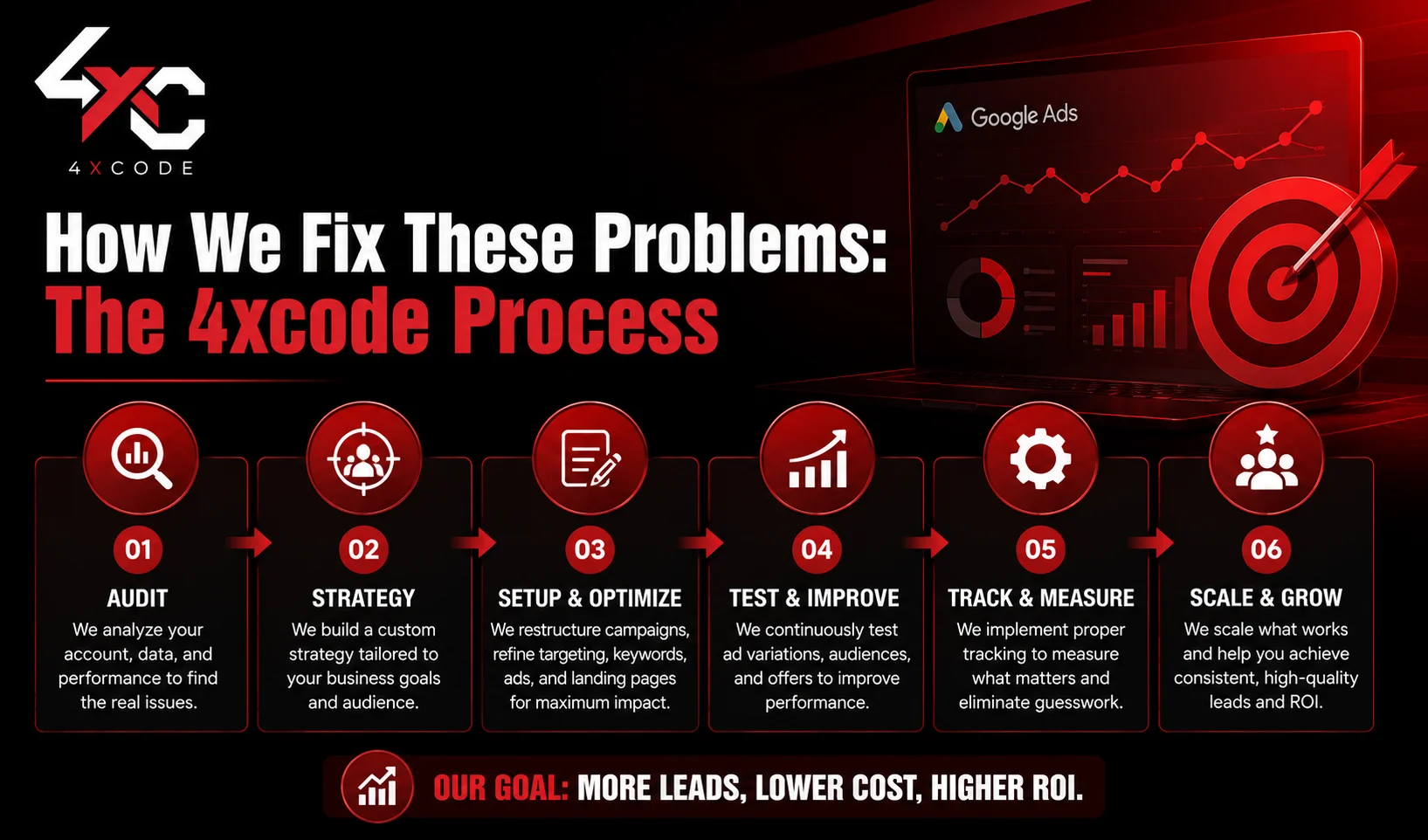
When a campaign isn't producing, we don't start by spending more. We start by finding the leaks. Here's the process we run at 4xcode to turn a draining account into one that delivers.
- Full account audit. We map your campaigns against the five-stage funnel above and pinpoint exactly where leads are being lost keywords, copy, page, or tracking.
- Keyword restructuring. We strip out the budget-wasters, build out buyer-intent and long-tail terms, tighten ad-group relevance, and layer in a proper negative keyword strategy.
- Landing page optimisation. As a development-led team, we don't just advise on the page, we build and fix it: dedicated, fast-loading, mobile-first pages with clear CTAs and genuine trust elements.
- Conversion tracking setup. We make sure every call and form is tracked accurately, so both you and Google's bidding are working from real data, not guesswork.
- Continuous A/B testing. Ads, headlines, and landing pages get tested and refined over time, because the first version is rarely the best one.
The thing that makes this stick: we can fix the technical side ourselves. When the people running your ads can also rebuild the landing page and repair the tracking, recommendations become results instead of a to-do list handed to "your web person."
The Real Impact: What Fixing the Structure Looks Like
We won't insult you with invented numbers. But the logic of improvement is consistent and worth understanding.
Picture a typical "before": broad keywords pulling mixed traffic, ads sending clicks to a generic homepage, no call tracking, and a bidding strategy chasing cheap clicks. The account spends its full budget and produces a trickle of low-quality enquiries. Worse, nobody can say which spend produced them.
Now the "after": tightened keywords filter out the researchers and bargain-hunters, so a higher share of clicks are real prospects. A dedicated landing page holds those visitors and gives them one clear action. Call and form tracking finally reveals which campaigns drive leads, so budget shifts toward what works. Bidding optimises toward actual conversions.
Same budget. Often less budget. But far more of it reaches genuine buyers, and far more of those buyers convert. That's the entire game: not spending more, but plugging the leaks so the money you already spend turns into leads.
Conclusion: Your Ads Aren't Broken, Your Structure Is
If your Google Ads campaign is not generating leads, resist the urge to blame the platform or simply throw more budget at it. In nearly every account we audit, the cause is structural: the wrong keywords, weak copy, a landing page that wasn't built to convert, no negative keyword strategy, broken tracking, or a bidding setup working against your goals.
Fix the structure and Google Ads becomes exactly what you hoped it would be, a reliable, measurable source of enquiries.
If you'd like a second pair of eyes on where your leads are leaking, we offer a free Google Ads audit and strategy call. We'll show you the specific points in your account that are costing you leads and exactly how to fix them. Visit www.4xcode.com to book yours.
Frequently Asked Questions
Why is my Google Ads campaign getting clicks but no leads?
Clicks without leads almost always point to a problem after the click usually the landing page, conversion tracking, or keyword intent. You may be attracting researchers instead of buyers, sending traffic to a page that doesn't convert, or failing to track the leads you're actually getting. Audit those three areas first.
How long does it take for Google Ads to start generating leads?
Most campaigns need two to four weeks to exit the learning phase and stabilise, assuming tracking is set up correctly and there's enough conversion data. If you're months in with no leads, the issue is structural, not a matter of patience.
How much should I spend on Google Ads to get leads?
There's no universal number, it depends on your industry, competition, and cost per lead. The smarter question is efficiency: a well-structured account with tight keywords, a strong landing page, and clean tracking will generate leads on a modest budget, while a poorly structured one wastes a large one.
Do I need a separate landing page for Google Ads?
In almost every case, yes. Dedicated landing pages built around the specific search intent convert significantly better than sending paid traffic to your homepage, because they match the visitor's exact need and remove distractions.
What are negative keywords and why do they matter?
Negative keywords stop your ads showing for irrelevant searches like "free," "jobs," or "DIY." They matter because every wasted click drains budget without any chance of becoming a lead. A maintained negative keyword list is one of the fastest ways to cut cost per lead.