
Your team is copying data between spreadsheets again. Two of your tools don't talk to each other. The system you bought five years ago can't keep up with how the business works now. And every "quick fix" you try seems to add another subscription.
At some point, off-the-shelf stops being enough. That's when you start searching for a software development company near you, someone you can meet, question and hold accountable.
4xcode plans, builds and maintains custom software for startups, SMEs and growing businesses: web applications, business tools, integrations and ongoing support. We work with clients across the UK (add your real city or service area here, and state clearly whether you meet in person, remotely or both).
This guide explains what a software development company actually does, how a project runs, what drives the cost, and how to judge any supplier before you sign. When you're ready to talk, you can request a custom software quote through 4xcode.com.
What Does a Software Development Company Do, and What Can 4xcode Build for Your Business?

A software development company plans, designs, builds, tests and maintains custom software around a business's specific needs. Instead of bending your process to fit a ready-made product, the software is shaped around how you really work.
That covers more than writing code. A good team also asks the right questions first, designs the experience, tests properly, launches safely and supports the product afterwards.
Which Custom Software Development Services Do Local Businesses Need Most?
Most businesses that come to a software house have one of a handful of problems. Here are the services that solve them, and the situation each one suits:
- Custom business applications. Internal tools built around your workflow, replacing spreadsheets, paper forms and disconnected systems.
- Web application development. Browser-based platforms such as customer portals, booking systems and dashboards that users reach from any device.
- Mobile app development. iOS and Android apps, built natively or cross-platform depending on budget and need.
- SaaS and MVP development. A focused first version of a product, so a startup can test the idea before investing in everything.
- Workflow automation. Software that removes repetitive manual work, such as re-keying data, chasing approvals or building weekly reports by hand.
- CRM and ERP development. Systems that manage customers, orders, stock and operations in one place.
- Reporting dashboards. Live views of the numbers that matter, instead of reports someone assembles on Friday afternoon.
- API and third-party integration. Connecting your existing systems, payment gateways and CRM so data flows without manual handoffs.
- Legacy software modernisation. Upgrading or replacing older applications that have become slow, insecure or hard to change.
(Confirm and edit this list so it names only the services 4xcode genuinely offers.)
Here's a typical scenario. A growing service business runs bookings from a shared spreadsheet, invoices from an accounting package and customer notes from an email inbox. Nothing is linked. A custom booking portal that feeds the accounts system and updates a live dashboard can turn three daily chores into none. That's the kind of practical outcome good software should deliver.
Our technology stack: (add your confirmed languages, frameworks, databases and cloud platforms here). We only list tools the team uses in real projects, because a long list of buzzwords proves nothing.
Is Custom Software Better Than Off-the-Shelf Software for Your Business?
Sometimes. Not always. The honest answer depends on how unusual your process is and how fast you need to move.
Factor | Custom software | Off-the-shelf or SaaS |
| Upfront cost | Higher | Lower |
| Fit to your process | Built around how you work | You adapt to the product |
| Scalability | Grows with your business | Limited by the vendor's plans |
| Ownership | Typically you own the code (confirm in contract) | Vendor owns the product, you rent access |
| Ongoing fees | Hosting and support | Per-user subscriptions that rise as you grow |
| Speed to launch | Weeks to months | Often immediate |
| Integration | Designed to connect to your systems | Depends on available connectors |
When off-the-shelf is the smarter choice. If a ready-made product already does 90% of what you need, buy it. Custom development earns its cost when your process is a real competitive advantage, when you're paying for several tools that don't connect, or when subscription fees are climbing every year.
We'll tell you if you don't need us. It's the quickest way to build trust, and it saves you money.
Not sure which route fits? Book a free project consultation and we'll talk it through.
How Does the Software Development Process Work, and What Happens After Launch?
A clear process is the best protection against late, over-budget or disappointing projects. You should know what happens at each stage, what you'll see, and what you're asked to approve.
What Are the Steps From First Conversation to Launch?
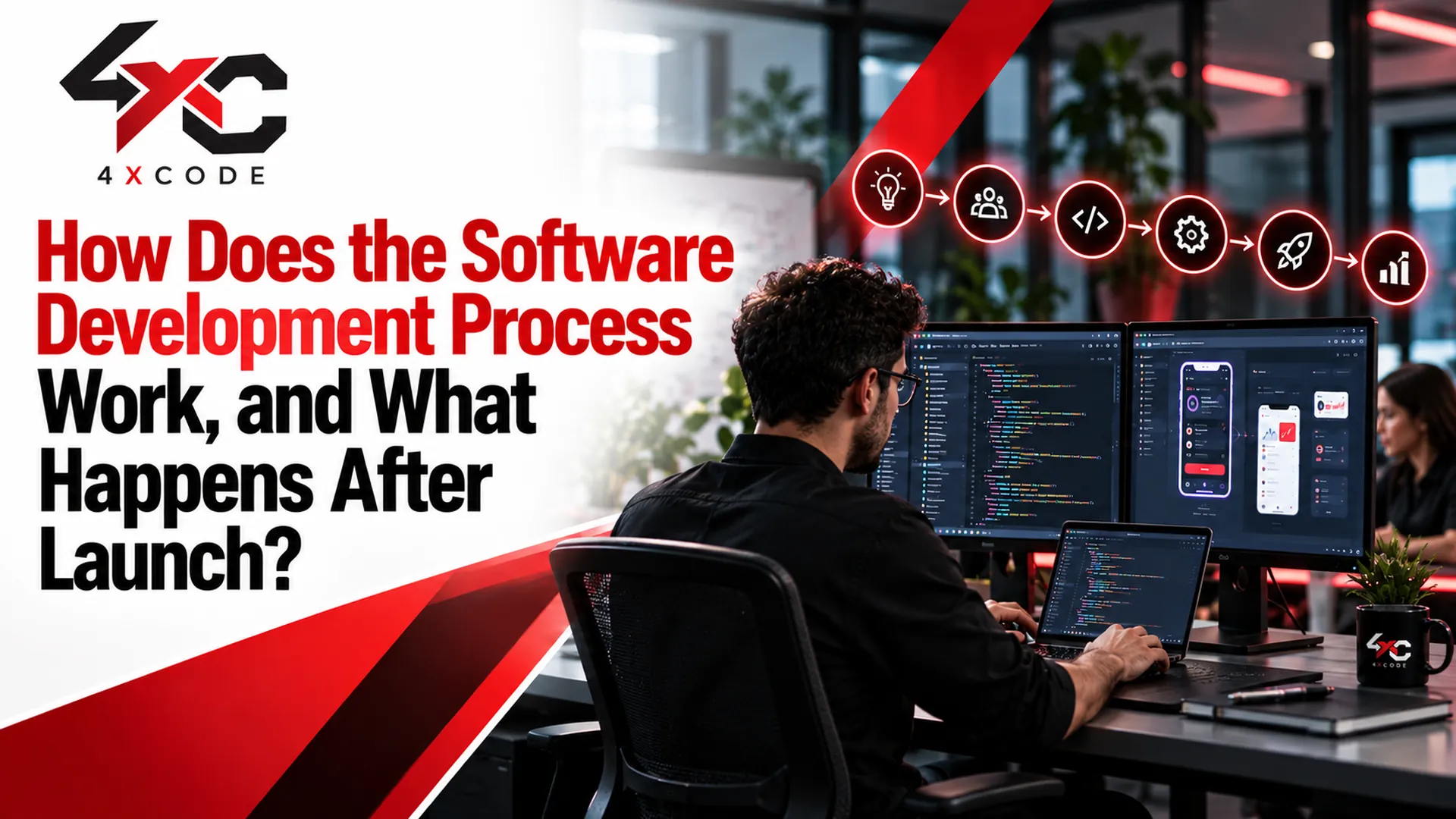
Here is how a typical 4xcode project runs (adapt the stages and wording to your real process):
- Discovery and requirements analysis. We learn your business, your users and the problem you want solved. We interview stakeholders and test whether the idea is feasible.
- Project scope and technical planning. We agree what's in and out of scope, the architecture, the integrations needed and a roadmap with milestones.
- UI/UX design and prototyping. Wireframes and interactive prototypes let you click through the product before a line of production code is written.
- Development in sprints. Work is delivered in short cycles with regular reviews, so you see progress and can steer it. This is agile software development in practice.
- Software testing and QA. Automated and manual testing check functionality, performance and security before anything goes live.
- Deployment and launch. We release to production, usually through a CI/CD pipeline, and monitor the first days closely.
- Post-launch support. Bug fixes, updates and improvements continue after go-live.
What you'll see and approve: a written scope, design prototypes, sprint demos and a final acceptance test. Progress is reported through (add your real update method and frequency, for example weekly calls or a shared board).
Clear communication matters as much as clean code. Most project problems start with a misunderstanding in week one, not a bug in week ten.
Who Owns the Code, and Do You Provide Ongoing Support and Maintenance?
These are two questions every buyer should ask before signing, and many suppliers avoid answering them clearly.
Ownership. Confirm in writing who owns the source code and intellectual property, who holds the hosting and cloud accounts, and whether full documentation is handed over. At 4xcode, (add your confirmed ownership terms here). You should never feel locked in to a supplier.
Support and maintenance. Software isn't finished at launch. It needs care. A maintenance agreement can cover:
- Bug fixing, so problems are corrected quickly
- Security updates, which protect your data as threats change
- Backups and monitoring, so a failure doesn't become a disaster
- Performance optimisation, as usage grows
- Enhancement requests, when your business needs something new
Our support terms: (add your confirmed terms, response times and what is and isn't covered).
Be wary of any supplier who can't explain what happens after launch. That's where hidden costs tend to live.
How Much Does Custom Software Development Cost, and How Long Does It Take?

The honest answer is that it depends. A simple internal tool and a multi-user platform with payment processing are very different projects. Rather than quote a number that could mislead you, we'll show you what moves the price, so you can judge any proposal fairly.
What Affects the Cost of Custom Software Development in the UK?
These are the main cost drivers:
- Complexity and number of features. More screens, rules and edge cases mean more design, build and testing time.
- User roles and permissions. A system with admins, managers and customers needs more planning than a single-user tool.
- Design and user research. A polished, well-researched interface takes time but improves adoption.
- Third-party integrations. Each connection to a CRM, payment gateway or accounting system adds work.
- Data migration. Moving clean data out of old systems is often underestimated.
- Security and compliance needs. Sensitive data demands extra safeguards and testing.
- Testing and deployment. Thorough QA protects you, and it has a cost.
- Ongoing support. Hosting, monitoring and maintenance continue after launch.
Fixed price or time-and-materials? Each suits a different kind of project:
Model | Best for | Advantage | Watch out for |
| Fixed price | Well-defined projects with a clear scope | Predictable budget | Changes mid-project can mean change requests |
| Time-and-materials | Evolving projects where requirements will shift | Flexibility, pay for work actually done | Needs good oversight and regular reporting |
Our pricing model: (add your real model, a "from £X" figure, or a clear explanation of how quotes are built). We don't invent prices here, because an honest quote comes from understanding your requirements, not guessing.
How long does it take? Timelines depend on scope. A focused MVP is typically much shorter than an enterprise platform with many integrations. Our typical timelines: (add your confirmed ranges by project type). Be cautious of anyone who promises an exact date before they've seen your brief.
Should You Hire a Local Software Company, a Freelancer or an Offshore Team?
Each option has a place. This comparison helps you decide:
Factor | Local software company | Freelancer | Offshore team |
| Communication | Same time zone, easy meetings | Direct, but one person | Time differences can slow things |
| Accountability | Contract, process and team behind you | Depends on one individual | Varies widely |
| Cost | Mid to higher | Often lowest | Often lower hourly rates |
| Continuity | Team cover if someone leaves | Risk if they become unavailable | Depends on the provider |
| Support | Ongoing maintenance available | Can be limited | Varies |
| IP protection | UK contracts and law | Depends on agreement | Can be harder to enforce |
A freelancer can suit a small, well-defined task. An offshore team can lower hourly costs when you can manage the project closely. A UK-based company tends to suit businesses that value clear accountability, easy conversation and long-term support.
Where does 4xcode fit? (State honestly where you operate and how remote collaboration works.) If you're outside our area, remote working is straightforward, with video calls, shared boards and regular demos keeping you close to the work.
Why Choose 4xcode as Your Software Development Partner, and How Do You Get a Quote?
Anyone can say they're the right choice. A trustworthy supplier shows you why. Here is what to ask for from us, or from anyone you're considering.
What Proof Can a Software Development Company Show Before You Hire It?
Look for evidence, not slogans:
- Real case studies. Each should explain the client's problem, the solution, the technologies used and a verified outcome. We publish: (add your genuine case studies and links).
- Client reviews and testimonials. Genuine, dated and specific. (Add real reviews or links to your profiles.)
- Named people. A founder, project lead and engineers whose experience you can check. (Add real names and credentials.)
- Relevant experience. Years in business and the sectors you've worked in. (Add real facts.)
- A clear approach to security and confidentiality. How data is protected, how access is controlled and how confidentiality is handled.
Treat bold claims with caution. "Number one," "cheapest" and "100% secure" aren't promises any honest developer can keep. We stick to what we can prove.
What Should You Bring to Your First Conversation, and How Do You Start?
You don't need a perfect specification. A short brief is enough. It helps to bring:
- The problem you want to solve, in plain words
- The tools you use today and what frustrates you about them
- Who will use the software, and roughly how many people
- A budget range, even approximate, so we can propose something realistic
- Your target timeline, and any fixed deadlines
- Integrations you need, such as accounting, CRM or payments
Here's what happens next. You send your brief through the form or by email. We reply within (add your real reply time). We arrange a discovery call, then send a written proposal with scope, timeline and cost, so you can compare us fairly with anyone else.
Request your custom software quote. Use the form at 4xcode.com, email us at (add email), call (add phone), or book a consultation at (add booking link). Service area: (add your real location or say UK-wide and remote).
Frequently Asked Questions About Software Development Companies
How much does custom software development cost?
It depends on complexity, features, integrations, design and support needs. A written proposal after a discovery conversation is the only reliable way to get an accurate figure.
How long does a software development project take?
A focused MVP can take weeks to a few months, while larger platforms take longer. Timelines depend on scope, feedback speed and integrations.
Can you integrate with our existing systems?
Usually yes, through APIs, webhooks and standard connectors. We check compatibility during discovery, so there are no surprises.
Who owns the software after delivery?
This should be stated clearly in your contract. Confirm ownership of source code, hosting and cloud accounts before signing with any supplier.
Do you provide ongoing maintenance?
Yes, (confirm your terms). Maintenance can cover bug fixes, security updates, backups, performance monitoring and new features.
Can a local software company work with clients in another city?
Yes. Video calls, shared project boards and regular demos make remote collaboration smooth, and many clients never need to visit in person.
What is the difference between web development and software development?
Web development focuses on websites and web interfaces. Software development is broader, covering business applications, back-end systems, integrations, mobile apps and more.
Is custom software better than off-the-shelf software?
It depends. Custom software suits unique processes and growing businesses. Ready-made products suit common needs and tight budgets.
Should I hire a freelancer or a software development company?
A freelancer can suit small, well-defined tasks. A company offers a team, a process, continuity and ongoing support, which matters for larger or longer-term projects.
Can legacy software be upgraded instead of replaced?
Often, yes. A software assessment can show whether modernising, rebuilding in stages or replacing is the best value.
How do software development companies price projects?
Most use fixed-price or time-and-materials models, or a mix. The right one depends on how well defined your requirements are.
How do I protect my intellectual property when hiring developers?
Use a written contract covering IP ownership, confidentiality and data protection. Ask any supplier to explain these terms before work begins.
How do we start a project?
Send a short brief through the quote form. We'll arrange a discovery call and follow up with a written proposal.
Final Word: Choose a Partner Who Shows Their Work
The right software development company doesn't just write code. It listens, plans carefully, communicates clearly and stays with you after launch. Look for a clear process, honest pricing, straight answers on ownership and support, and real proof of past work.
If spreadsheets, disconnected tools or outdated software are holding your business back, a short conversation could save you months of frustration.
Ready to talk? Request your custom software quote at 4xcode.com or book a free project consultation today.