
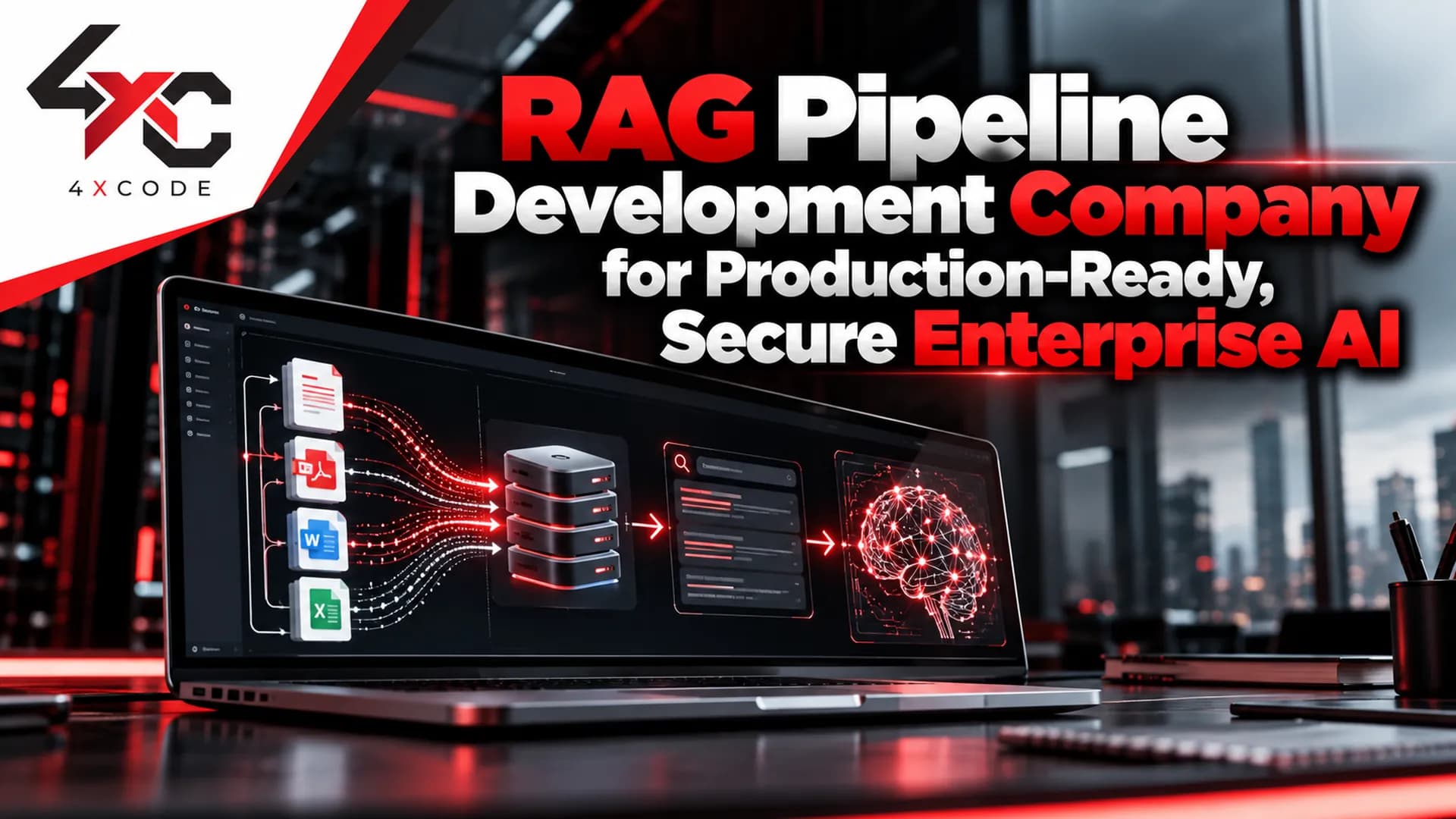
Your team built an AI assistant. In the demo, it looked brilliant. Then someone asked about a real contract, a policy updated last week, or a customer record, and they answered with total confidence and got it wrong. Or it couldn't see your private data at all.
That gap between a demo and a system your business can trust is exactly where a RAG pipeline development company earns its fee. This page explains what a production RAG pipeline involves, how accuracy gets measured, how private data stays protected, what drives cost and timeline, and how to choose the right partner. 4xCode is a UK-based engineering team. If you'd rather talk it through, you can.
What Does a RAG Pipeline Development Company Build, and How Does a Production RAG Pipeline Work?
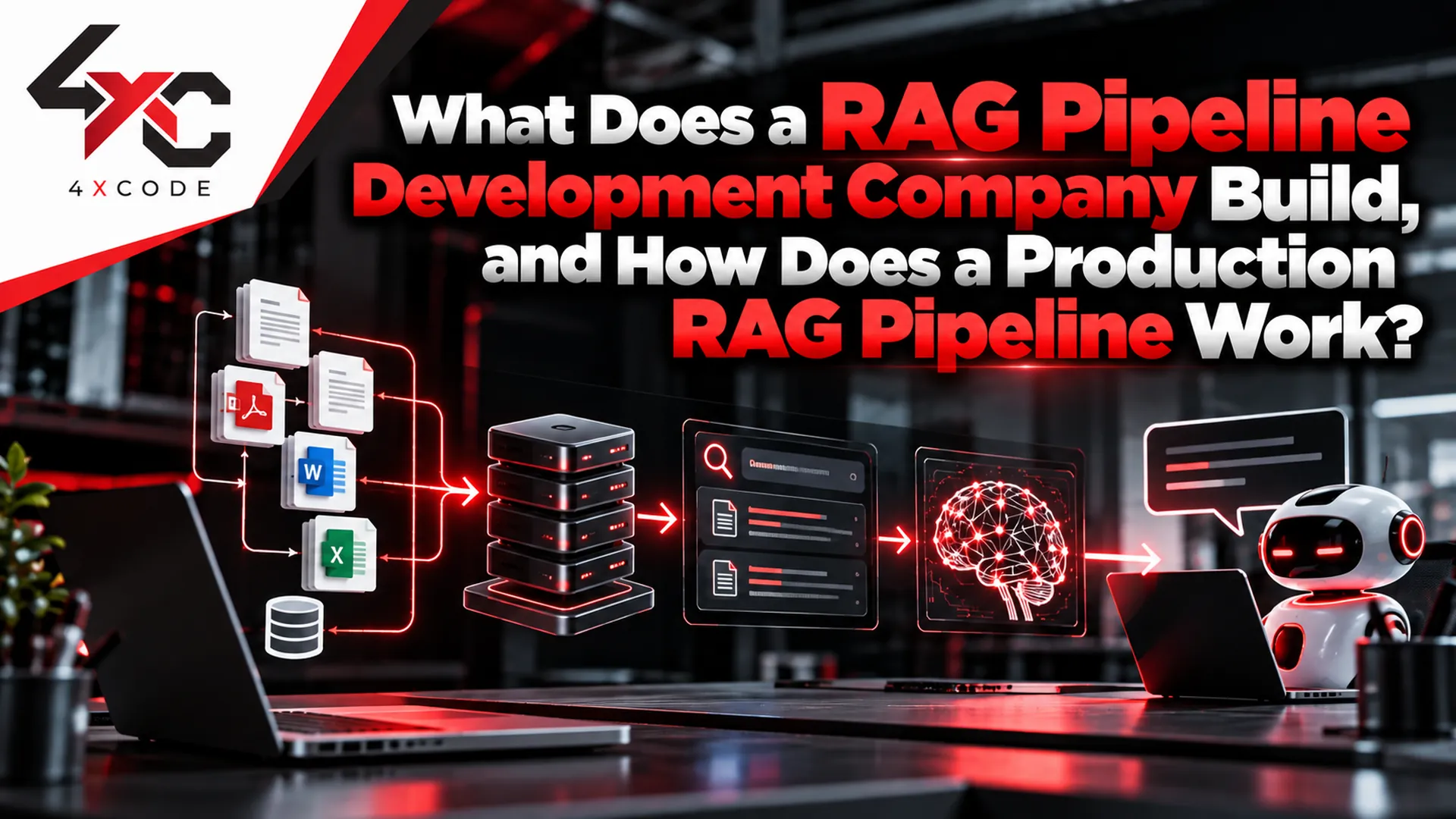
The short answer: a RAG development company designs and builds the system that connects a large language model (LLM) to your private data. It ingests and chunks your documents, creates embeddings, retrieves and reranks the most relevant context, generates answers with source citations, then evaluates and monitors quality once the system is live.
Retrieval-Augmented Generation (RAG) lets an LLM answer from your proprietary data at the moment a question is asked. The model doesn't need retraining each time your knowledge changes. You update the index, and the answers follow.
The catch is that the quality of the whole system depends on the weakest stage in the pipeline. That is why "we'll plug in a vector database" is not a plan.
How Do You Build a RAG Pipeline: From Document Ingestion and Chunking to Hybrid Search, Reranking and Citations?
Here is the path a question travels, and the path your documents take before it arrives.
- Data sources. Policies, PDFs, wikis, support tickets, databases and shared drives. Structured and unstructured data both qualify.
- Ingestion and parsing. Text is extracted and cleaned. Scanned files go through OCR. Metadata such as author, date, department and permissions is captured.
- Chunking. Documents are split into passages the model can use. Semantic or hierarchical chunking usually beats fixed-size splits, because it respects meaning and structure.
- Embeddings. Each chunk is converted into a vector using an embedding model chosen for your domain and language.
- Vector database. Embeddings are stored and indexed for fast similarity search.
- Hybrid retrieval. Keyword search (BM25) and semantic vector search run together. Keywords catch exact terms like part numbers and clause references. Vectors catch meaning.
- Metadata filtering. Results are narrowed by date, source, department or user permission.
- Reranking. A reranker, often a cross-encoder, reorders candidates so the most relevant context rises to the top.
- Context assembly and generation. The best passages are placed into the prompt, and the LLM writes an answer grounded in them.
- Source citations. Every answer points back to the passages it used, so users can verify it.
Each stage can fail, and knowing where is half the job:
Stage | Purpose | Common failure | How a good build addresses it |
| Ingestion | Get clean text and metadata | Tables, scans and layouts parsed badly | Document-specific parsers, OCR, quality checks |
| Chunking | Create usable passages | Chunks split mid-idea or too large | Semantic or hierarchical chunking, tested overlap |
| Embeddings | Represent meaning | Model mismatched to domain | Embedding selection tested on your own data |
| Retrieval | Find relevant context | Misses exact terms or paraphrases | Hybrid search with metadata filters |
| Reranking | Prioritise the best context | Noisy results reach the model | Cross-encoder reranking, contextual compression |
| Generation | Produce the answer | Unsupported claims | Grounded prompts, citations, guardrails |
| Indexing | Keep knowledge current | Stale or duplicated documents | Continuous re-indexing and freshness checks |
A scenario we see often. A support team loads thousands of help articles into a vector database and gets mediocre answers. The problem isn't the model. Long articles were chunked at fixed lengths, so answers were split across passages, and exact product names weren't matched because there was no keyword layer. Fixing chunking and adding hybrid retrieval with reranking improves results far more than swapping the LLM.
Which Advanced RAG Services Do We Offer: Graph RAG, Agentic RAG, Multimodal RAG and Private Deployments?
Basic RAG answers a question from a handful of passages. Some problems need more. These are the advanced options, and who they suit:
- Graph RAG and knowledge graphs. Best when answers depend on relationships between entities, such as contracts, suppliers, regulations or product hierarchies.
- Agentic and multi-step RAG. Suits complex questions that need query decomposition, routing to different sources or several retrieval steps before answering.
- Multimodal RAG. For knowledge held in images, diagrams, scanned forms or mixed documents as well as text.
- RAG chatbots and enterprise knowledge assistants. Customer-facing or internal assistants grounded in your content, with citations.
- Enterprise AI search. Semantic search across your document estate, with or without a generated answer.
- Private deployments. Cloud, hybrid or on-premise options where data cannot leave your environment.
On tools: we choose vector databases, frameworks, LLM providers and cloud platforms around your data, security needs and budget, not the other way round.
How Do You Make a RAG System Accurate, Secure and Reliable in Production?
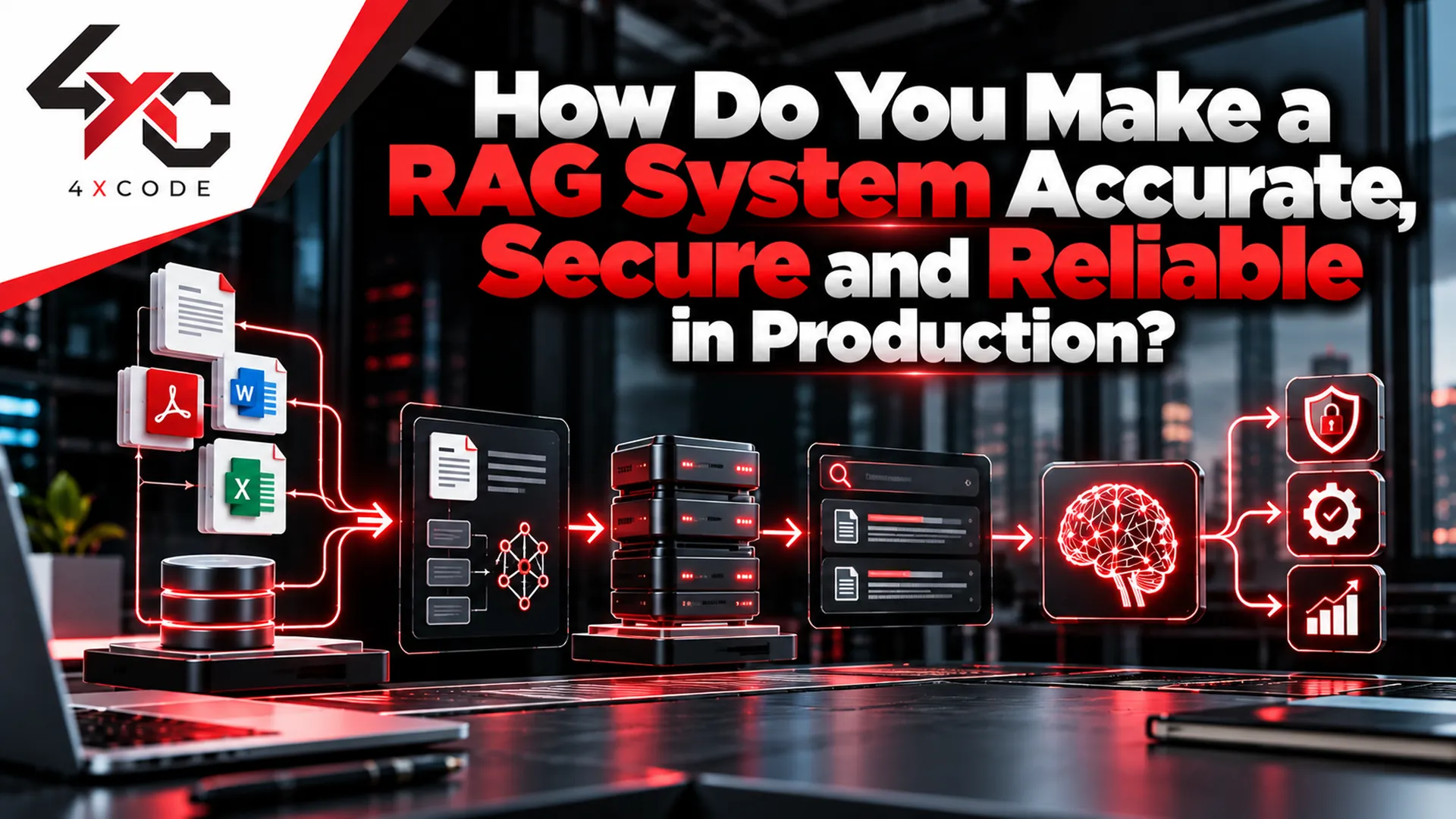
A working prototype proves the idea. A production system proves the engineering. The difference is measurement, protection and upkeep.
How Do You Measure and Improve RAG Accuracy and Reduce Hallucinations?
Let's be direct: RAG reduces hallucinations. It does not eliminate them. Anyone promising "zero hallucinations" or quoting an accuracy percentage without explaining how it was measured is selling, not engineering.
Real accuracy work is measurable. It usually covers:
- Retrieval precision and recall. Did the system fetch the right passages, and did it miss any?
- Context relevance. Was the retrieved material actually useful for the question?
- Faithfulness (groundedness). Does the answer stick to the retrieved sources?
- Answer relevance. Does it answer what was asked?
- Citation accuracy. Do the cited sources support the claim made?
- Golden test sets. A curated set of real questions with verified answers, built with your subject-matter experts.
- Regression testing. Re-running those tests after every change to chunking, embeddings, prompts or models, so improvements in one place don't quietly break another.
Evaluation frameworks such as RAGAS and DeepEval can automate parts of this. Automated scores still need human review, especially for high-stakes content.
What improves accuracy in practice, roughly in order of impact: better parsing and chunking, hybrid retrieval, reranking, query rewriting and decomposition, tighter prompts, and finally model choice. Guardrails and "I don't know" behaviour matter too. An assistant that admits it can't find an answer is more valuable than one that guesses.
Can RAG Work With Private, Confidential Data, and How Do Access Control and Monitoring Work?
Yes, and for most businesses private data is the whole point. But it has to be designed from day one, not bolted on.
Security and access control
- Permission-aware retrieval. Users only retrieve what they're allowed to see. Permissions travel with each document chunk.
- Role-based access control (RBAC) and, where needed, multi-tenant isolation so one client's or department's data never reaches another.
- Encryption in transit and at rest.
- Audit logs showing who asked what and which sources were used.
- Deployment choices. Cloud, hybrid or on-premise, depending on where your data is allowed to live.
On compliance, we design with UK GDPR principles in mind, such as data minimisation and access control. That is not the same as holding a certification, and we won't imply otherwise.
Monitoring after launch
A RAG system changes as your data changes. Good monitoring tracks:
- Retrieval and answer quality drift as documents are added or updated
- User feedback loops, such as thumbs up or down and flagged answers
- Continuous re-indexing, so new knowledge appears and old knowledge expires
- Latency and cost, since long contexts and heavy reranking add up
- Failure patterns, such as questions the system repeatedly can't answer
How Much Does RAG Pipeline Development Cost, How Long Does It Take, and How Do You Choose the Right Partner?
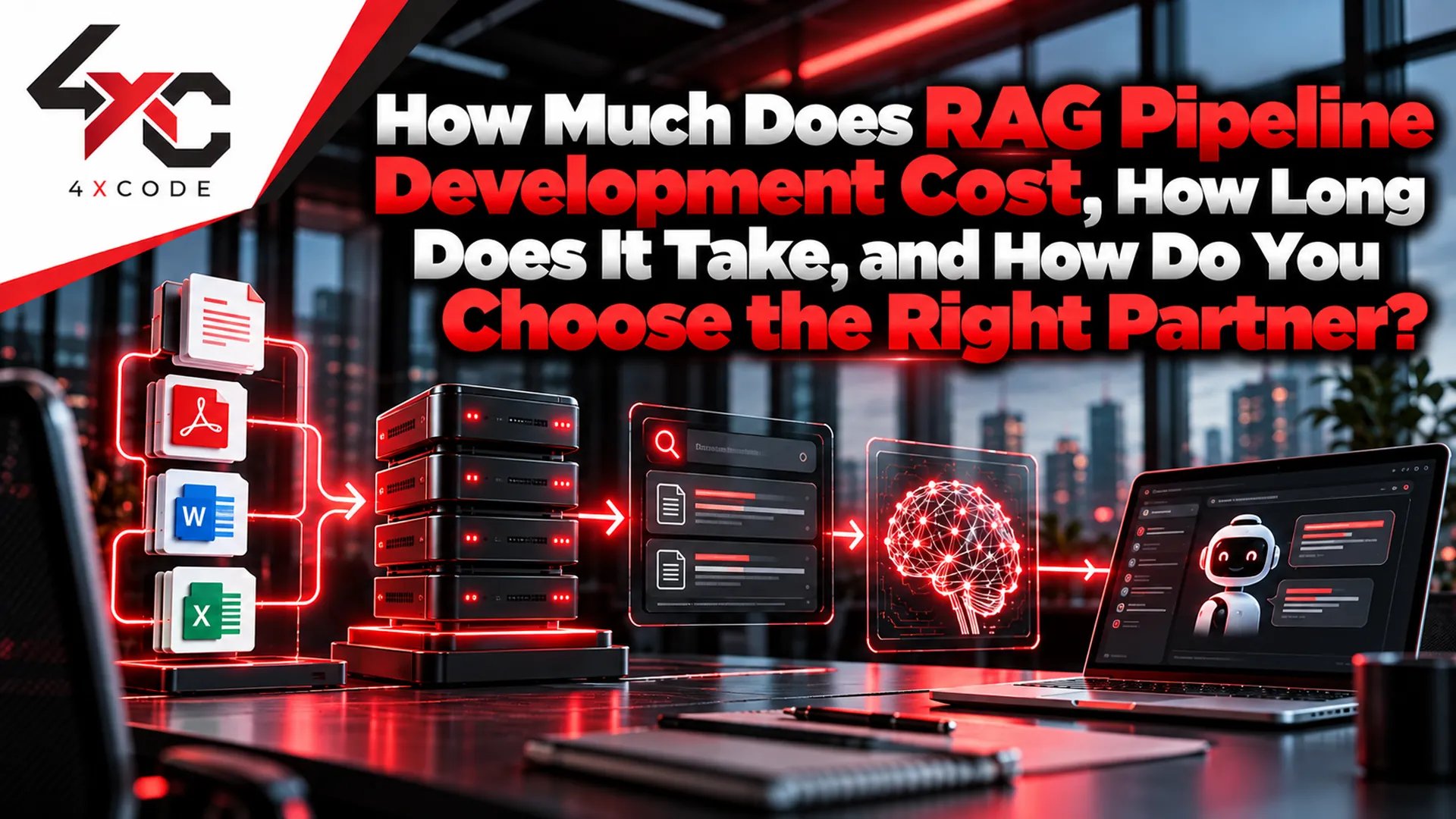
You'll find wildly different numbers online, usually without any basis. We'd rather show you what moves the price, so you can judge any quote, ours included.
How Much Does RAG Development Cost and How Long Does a Project Take, and When Should You Choose RAG Over Fine-Tuning?
What drives cost
Cost driver | Why it matters |
| Data volume and quality | Messy, scanned or inconsistent documents need more preparation |
| Number of sources and integrations | Each connector (SharePoint, Confluence, CRM, databases) adds build and testing time |
| Security and permissions | Permission-aware retrieval and audit logging take real engineering |
| Evaluation depth | Golden datasets and regression testing take expert time but protect quality |
| Deployment model | On-premise or private cloud costs more than a managed service |
| Running costs | LLM usage, embeddings, vector storage and cloud infrastructure recur monthly |
| Maintenance | Re-indexing, tuning and monitoring continue after launch |
Typical project phases
A proof of concept is the safest way to start. It tests your real data before you commit to a full build.
RAG vs fine-tuning vs long context
These are often presented as rivals. They solve different problems.
Factor | RAG | Fine-tuning | Long context |
| Current information | Strong, update the index | Weak, needs retraining | Strong, but you must supply it each time |
| Private documents | Strong | Possible | Possible, within window limits |
| Citations | Strong | Weak | Possible |
| Updating knowledge | Re-index | Retrain | Replace the context |
| Style and behaviour change | Limited | Strong | Limited |
| Access control | Strong, per document | Weak | Depends on setup |
| Cost profile | Variable, mostly running costs | Higher upfront training cost | Token-dependent, can grow quickly |
When RAG is the right choice: your knowledge changes often, lives in private documents, and answers need sources.
When it isn't: you need a model to adopt a specific tone or skill (fine-tuning), your knowledge is tiny and static (a well-written prompt may do), or the problem is simple search with no need for generated answers. We'll tell you if that's your situation.
How Do You Choose a RAG Development Company, and What Questions Should You Ask Before Hiring One?
Whether you choose us or someone else, use this checklist.
- Can they show production deployments, not just demos?
- How do they measure accuracy? Ask for their evaluation method and tools.
- How do they handle permissions and data security?
- Are they tool-independent, or do they push one vendor?
- Who owns the code, pipelines and data? It should be you.
- What happens after launch? Monitoring, re-indexing and support should be in scope.
- Is scope and pricing clear, with milestones and deliverables?
Red flags:
- "95% accuracy" with no explanation of how it was tested
- Portfolios made of chatbot demos, with nothing in production
- No mention of evaluation, permissions or monitoring
- Vague answers about where your data is stored or processed
Build, buy or hire a freelancer? Building in-house gives control but needs scarce skills and time. Off-the-shelf tools suit simple needs but struggle with complex data and permissions. A specialist company suits teams that need production quality without building a RAG engineering function from scratch. A freelancer can work for a small, well-defined proof of concept, but covering evaluation, security and ongoing support is harder for one person.
How Do You Start a RAG Project With 4xCode, and What Happens on the Discovery Call?
It's deliberately simple:
- Tell us your use case and data sources. What should the system answer, for whom, and from which documents?
- We review feasibility and architecture. You get an honest view of whether RAG fits, the likely approach and the main risks.
- We agree a proof of concept. Defined scope, success metrics and timeline, before any larger commitment.
Why 4xCode? Evaluation-first engineering, security designed in from the start, and a UK-based team.
Frequently Asked Questions About RAG Pipeline Development
What is a RAG pipeline?
A RAG pipeline is the system that lets an LLM answer from your own data. It ingests and chunks documents, stores embeddings in a vector database, retrieves and reranks relevant passages for each question, then generates an answer with citations.
What does a RAG development company do?
It designs, builds, tests and deploys the pipeline end to end: data ingestion, retrieval, LLM integration, security, evaluation and monitoring, and often supports it after launch.
How much does RAG development cost?
It depends on data volume and quality, number of integrations, security needs, evaluation depth and deployment model, plus ongoing running costs. Start with a proof of concept to scope the real figure.
How long does a RAG project take?
A proof of concept is typically faster than a production build, but timelines depend on data readiness and integrations.
Can RAG work with PDFs, scanned documents and databases?
Yes. PDFs and Office files are parsed, scanned documents go through OCR, and databases can be queried or indexed. Quality depends heavily on how well each format is processed.
How do you reduce RAG hallucinations?
Better chunking, hybrid retrieval, reranking, grounded prompts, citations, guardrails and continuous evaluation against a golden test set. These reduce hallucinations. They don't remove them entirely.
Which vector database is best for RAG?
There's no single best option. The right choice depends on scale, hosting preference, filtering needs, existing infrastructure and budget. Options include Pinecone, Qdrant, Weaviate, Milvus, Chroma and pgvector.
Should I build or buy a RAG solution?
Build in-house if you have the skills and time. Buy off-the-shelf for simple needs. Hire a specialist when you need production quality, security and evaluation without building the capability yourself.
How do I choose a RAG development company?A
Ask for production examples, their evaluation method, their approach to permissions and data security, who owns the code and what support follows launch.
What is hybrid search in RAG?
It combines keyword search (such as BM25) with semantic vector search, then reranks the results. This catches both exact terms and meaning, and usually outperforms either alone.
What is the difference between RAG and fine-tuning?
RAG gives a model access to external, updatable knowledge at question time. Fine-tuning changes the model's behaviour or style through additional training. Many projects use RAG for knowledge and, occasionally, fine-tuning for tone.
Final Word
A RAG system is only as good as its weakest stage: parsing, chunking, retrieval, reranking, generation, evaluation, security and monitoring. Get those right and you have an assistant your team can rely on, with answers they can check. Skip them and you have a demo.
If you're weighing a build, the safest first step is a short discovery conversation and a focused proof of concept on your real data.