
Running an independent garage in 2026 without a proper management system is a bit like trying to fix an engine with only a spanner. You can get by, but you're working harder than you need to, and something's always slipping through the cracks a missed MOT reminder, a job card that got lost on the workshop floor, a customer who never got their invoice.
If you're reading this, you've probably felt that friction already. Maybe your technicians are still scribbling job notes on paper. Maybe your booking diary is a wall calendar that three people are trying to update at once. Maybe you're chasing payments manually because there's no system tracking who owes what.
This guide walks through exactly what an independent garage modern management system does, what features actually matter (not just what vendors claim matters), how the leading UK platforms compare, and how to choose the right one for your workshop's size and growth plans.
What Is an Independent Garage Modern Management System?
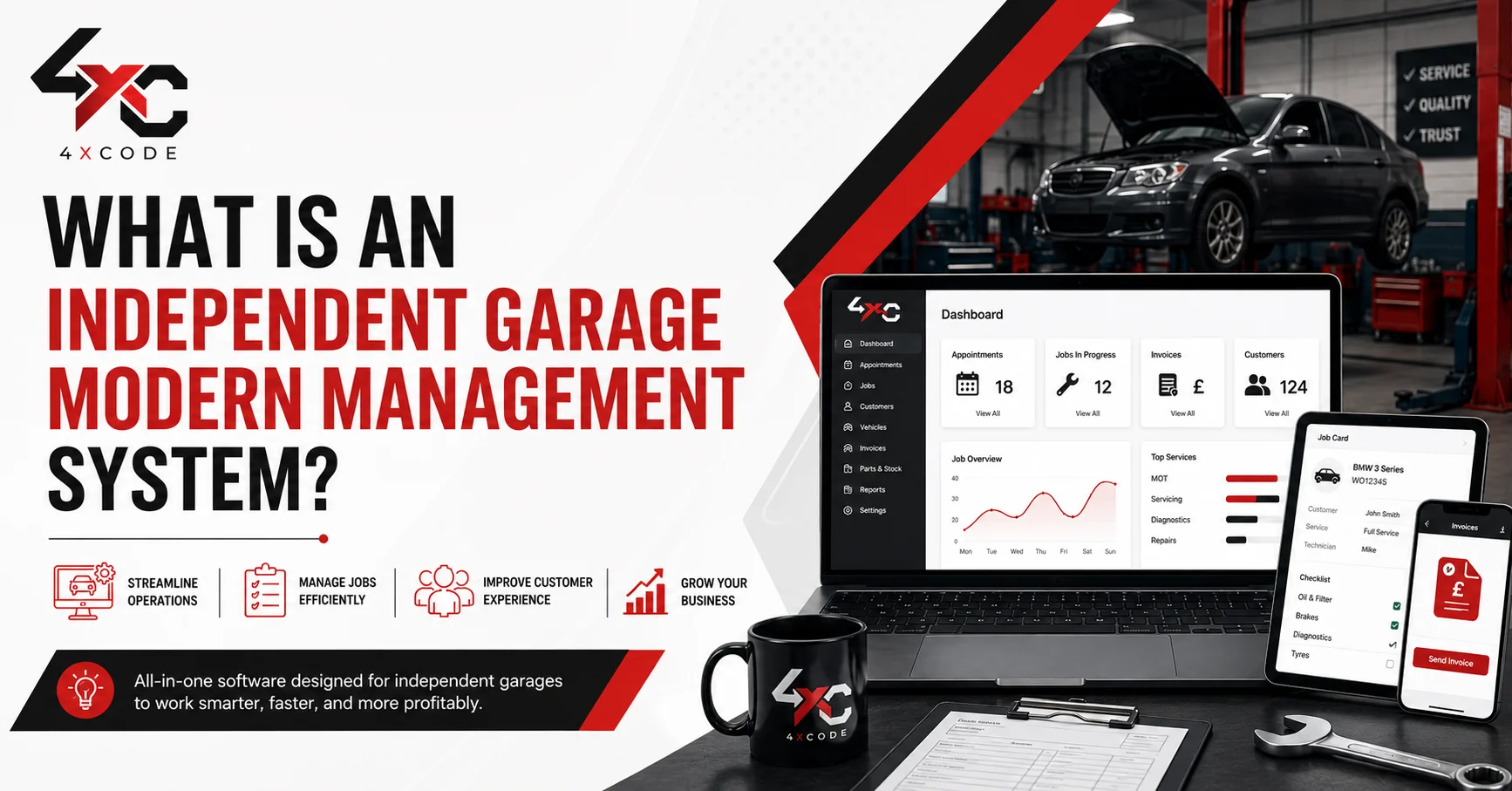
An independent garage modern management system is software built specifically to run the day-to-day operations of a vehicle repair or servicing business from the moment a customer books an appointment to the moment they collect their car and pay the invoice.
Unlike generic business software, it's designed around the specific rhythm of workshop life: job cards, technician scheduling, parts ordering, MOT tracking, and customer communication all in one connected system, rather than scattered across spreadsheets, paper files, and separate apps.
How Does a Garage Management System Actually Work?
At its core, the system centralises everything that used to live in separate places. A customer books online or calls in, and that booking automatically creates a job card. The job card tracks the vehicle's service history, the technician assigned, the parts needed, and the labour time logged. Once the work is done, the system generates the invoice, often with digital signatures and payment processing built in.
Most modern platforms are cloud-based, meaning your workshop diary, customer records, and reporting dashboard are accessible from any device the front desk, the workshop floor, or a technician's mobile app during a home visit or mobile service call.
Who Needs One, And Who Can Manage Without It?
Realistically, any workshop handling more than a handful of jobs a week benefits from a proper system. A one-person garage doing occasional repairs might survive on paper and memory for a while. But the moment you have multiple technicians, a steady flow of bookings, or ambitions to grow, manual tracking becomes the bottleneck.
Workshops that benefit most include:
- Independent garages scaling from one site to multiple locations, where consistency across sites matters
- Fast-fit and MOT-focused workshops, where booking volume and DVSA compliance are constant pressures
- Fleet servicing businesses, where multiple vehicles need tracked maintenance histories
- General repair shops juggling diagnostics, servicing, and bodywork simultaneously
If any of that sounds like your workshop, the ROI on a management system tends to show up within the first few months mostly through time saved and fewer missed bookings.
What's the Difference Between Garage Software, Workshop ERP, and Garage CRM?
These terms get used interchangeably, but they're not quite the same thing, and understanding the distinction helps when you're comparing platforms.
Garage software is the broad umbrella term any digital tool built for workshop operations. Workshop ERP (Enterprise Resource Planning) typically refers to more comprehensive systems that also handle inventory, accounting integration, and multi-site reporting the kind of depth larger workshops need. Garage CRM focuses specifically on the customer relationship side: booking history, communication logs, service reminders, and retention tools.
Most modern platforms, including 4xcode, blend all three into a single system, so you're not stitching together separate tools for scheduling, customer management, and financial reporting.
Key Features Every Modern Workshop Needs
Not every garage management system is built the same, and the feature list on a sales page doesn't always reflect what actually helps day-to-day. Here's what genuinely matters.
Job Cards, Repair Orders & Digital Vehicle Inspections
Digital job cards replace the paper trail that so easily gets lost or damaged on a busy workshop floor. A good system lets technicians update job cards in real time, attach photos from digital vehicle inspections, and flag additional work needed all visible to the front desk instantly.
Digital vehicle inspections (DVIs) are particularly valuable for building customer trust. Instead of telling a customer their brake pads need replacing, you can show them a photo taken during the inspection. This single feature does a lot of heavy lifting for both transparency and upselling additional work honestly.
Online Booking, Scheduling & Technician Allocation
Workshop scheduling software should do more than just fill a diary. It should account for technician availability, bay capacity, and job duration, so you're not accidentally double-booking a technician or underestimating how long a job will take.
Online booking systems also reduce the phone-call burden on your front desk. Customers can see available slots and book directly, which cuts down on missed calls a bigger problem than most garage owners realise, since a missed call often means a missed booking that goes straight to a competitor.
Parts, Inventory & Supplier Integration
Stock control is one of the most overlooked areas of workshop management, and one of the most expensive to get wrong. Running out of a common part mid-job stalls the whole workflow. Overstocking ties up cash you could use elsewhere.
A solid inventory management feature tracks stock levels in real time and can integrate with suppliers like GSF Car Parts or LKQ Euro Car Parts, so reordering happens automatically or with minimal manual input. Some systems even suggest parts based on the job type, cutting down the time technicians spend searching parts catalogues.
Reporting, KPIs & Business Intelligence
You can't improve what you don't measure. A reporting dashboard turns raw workshop data labour hours, job completion times, revenue per technician, parts margins into numbers you can actually act on.
What KPIs Should an Independent Garage Track Monthly?
The KPIs that matter most for independent garages tend to be:
- Technician utilisation rate how much of a technician's paid time is spent on billable work
- Average job turnaround time how long jobs take from check-in to completion
- First-time fix rate how often a repair is resolved without the vehicle returning
- Customer retention rate how many customers rebook within 12 months
- Parts margin the profit made on parts versus labour
Tracking these consistently, even just monthly, tends to reveal inefficiencies that are invisible day-to-day but add up significantly over a year.
MOT Reminders & DVSA Integration
MOT reminders are one of the simplest features to set up and one of the most reliable ways to generate repeat business. Automated SMS or email reminders sent a few weeks before a customer's MOT is due keep your garage top of mind without any manual chasing.
Does Garage Software Need to Integrate with DVSA?
For workshops that carry out MOT testing, DVSA integration isn't optional it's how test results get submitted and how the system pulls accurate MOT due dates for reminder automation. Without this integration, you're relying on manual lookups, which wastes time and increases the risk of errors in compliance reporting.
Independent Garage Software vs Traditional Workshop Methods
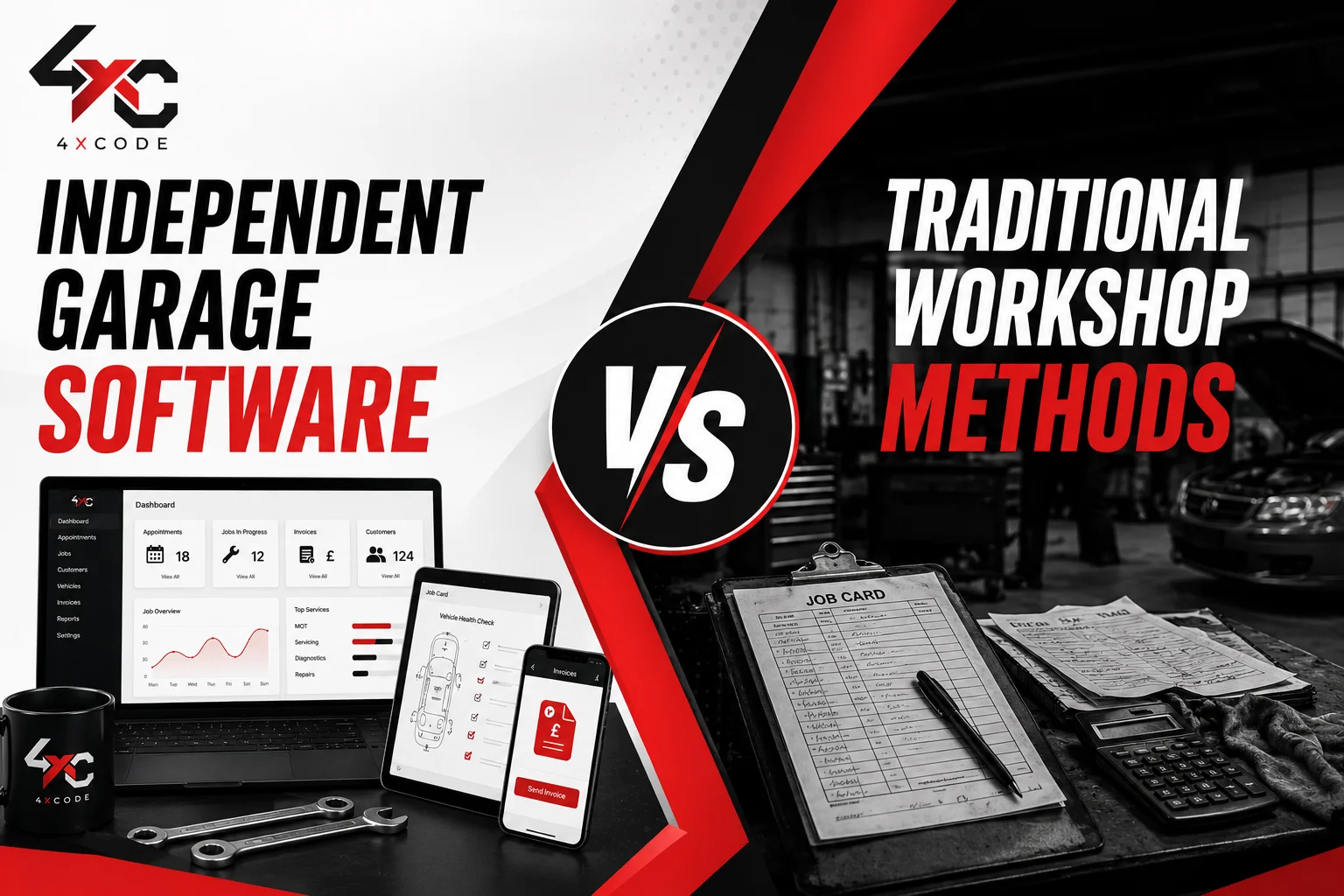
It's worth being honest about the trade-offs here, because switching systems is a real investment of time and money, and it shouldn't be done just because it's trendy.
Cloud-Based vs On-Premise Garage Software, Which Is Better for UK Workshops?
Factor | Cloud-Based Software | On-Premise / Traditional Methods |
| Access | Available from any device, anywhere | Limited to on-site computers |
| Updates | Automatic, no manual installation | Manual updates, often delayed |
| Data backup | Automatic cloud backup | Requires manual backup discipline |
| Upfront cost | Lower, subscription-based | Higher setup and hardware cost |
| Multi-site support | Built in for most platforms | Often requires separate systems per site |
| Mobile access | Standard on most platforms | Rare or requires additional tools |
For the vast majority of independent UK workshops today, cloud-based systems win on flexibility and cost, particularly for garages considering expansion to a second or third site down the line.
How Much Does Garage Management Software Cost in the UK?
Pricing varies significantly depending on workshop size and feature depth, but most UK platforms fall into a few general bands. Entry-level plans for single-site independent garages often start in the range of £50 to £150 per month. Mid-tier plans with fuller feature sets , inventory management, advanced reporting, multi-user access ,typically run £150 to £400 per month. Multi-site or enterprise setups with custom integrations can run higher, priced individually based on requirements.
It's worth requesting a demo or free trial from any platform you're considering rather than committing based on pricing pages alone, since the real value shows up in how the system fits your actual workflow.
What Happens If You Don't Modernise Your Workshop Systems?
This is the question worth sitting with honestly. Workshops that delay modernising tend to face a slow accumulation of small losses rather than one dramatic failure: a few missed bookings a month, a slightly higher error rate on invoicing, a bit more time spent on admin that could go toward billable work.
None of it feels urgent in isolation. But over a year, it adds up to real lost revenue and a workshop that's harder to scale, harder to staff efficiently, and more vulnerable to competitors who've already made the switch.
How to Choose the Right Garage Management System (and Why 4xcode)
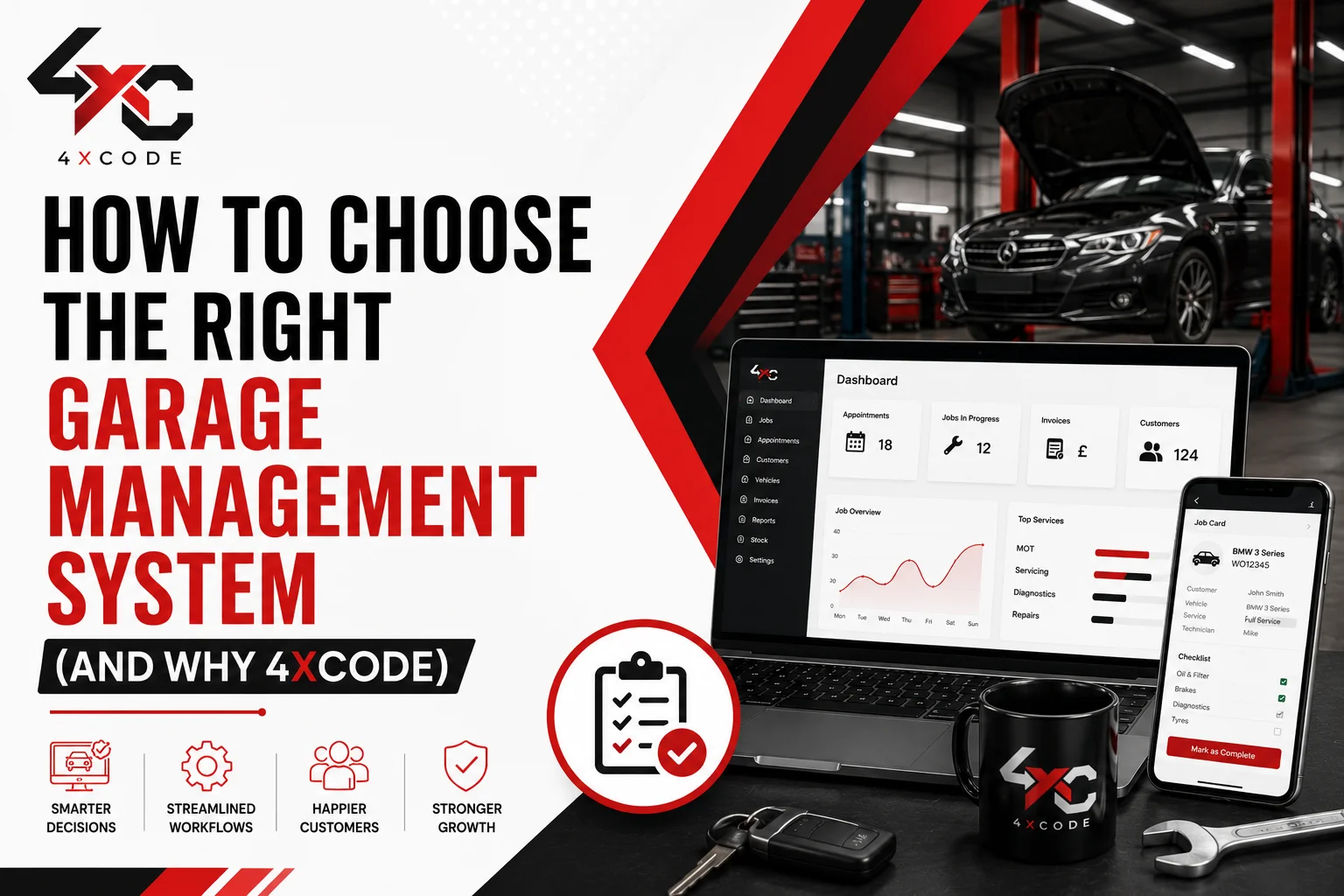
With the groundwork covered, here's how to actually make the decision — because the "best" system depends heavily on your workshop's size, structure, and goals.
How to Choose Garage Software Based on Workshop Size
Best Setup for Small Independent Garages
Smaller workshops ,typically one to three technicians , should prioritise simplicity and speed of setup over depth of features. Look for platforms with straightforward job card management, online booking, and MOT reminders as core functions, without paying for enterprise-level reporting you won't use yet.
Best Setup for Multi-Site Workshops
Multi-site operations need centralised reporting across locations, consistent inventory tracking, and role-based access so managers can see performance at each site without technicians accessing data outside their own workshop. Integration with accounting software like Xero, QuickBooks, or Sage becomes far more valuable at this scale, since consolidating financials across sites manually is genuinely painful.
Why UK Garages Are Switching to 4xcode
Many independent workshops start with a basic system and outgrow it within a year or two, then face the disruption of migrating everything to a new platform. 4xcode was built to remove that ceiling from the start , designed to work equally well for a single-bay independent garage and a growing multi-site operation, without forcing a switch later.
Key Strengths of 4xcode's Platform
- Unified job cards and digital inspections, keeping technicians and front desk staff working from the same live data
- Automated MOT and service reminders, reducing no-shows and keeping repeat business flowing without manual chasing
- Real-time inventory and supplier integration, cutting down on stalled jobs due to missing parts
- Built-in reporting dashboards, giving owners visibility into KPIs without needing a separate analytics tool
- Cloud access from any device, so front desk, technicians, and management stay connected whether they're in the workshop or off-site
- Accounting software integration, syncing invoicing and payments directly with platforms like Xero and QuickBooks
The goal isn't just replacing paper with software , it's giving independent garages the same operational depth that larger chains have, without the complexity or cost that usually comes with it.
Frequently Asked Questions
What Is the Best Garage Management Software in the UK?
There's no single "best" platform for every workshop ,it depends on your size, technician count, and whether you need multi-site support. Independent garages generally do best with a cloud-based platform offering job cards, online booking, MOT reminders, and inventory management as a baseline, then scaling up features as the business grows.
Can Garage Software Integrate with Booking and MOT Systems?
Yes. Most modern garage management platforms, including 4xcode, integrate directly with online booking calendars and DVSA systems for MOT tracking. This means booking data flows straight into job cards, and MOT due dates are pulled automatically rather than tracked manually.
Can I Switch Garage Software Without Losing Customer Data?
In most cases, yes. Reputable providers offer data migration support when you switch, transferring customer records, vehicle history, and past job cards into the new system. It's worth confirming this directly with any provider before committing, and asking specifically how historical service records are handled during migration.
Is Cloud Garage Software Secure for Independent Workshops?
Cloud-based platforms generally offer stronger security than manual or on-premise systems, since reputable providers use encrypted data storage and automatic backups. That said, it's worth confirming a provider's specific data protection practices, particularly around customer information and payment processing, before signing up.
Final Thoughts
An independent garage modern management system isn't really about replacing paper with a screen. It's about removing the small daily frictions that quietly cost workshops time, money, and repeat customers , a missed MOT reminder here, a lost job card there, a booking that never made it into the diary.
The workshops that make the switch tend to notice the difference within weeks, not months: fewer missed bookings, tighter technician scheduling, and a much clearer picture of where the business actually stands financially.
If you're ready to see what that looks like for your own workshop, 4xcode offers a straightforward way to explore the platform firsthand , built for UK independent garages that want the operational depth of a larger system without losing the flexibility that makes independent workshops work. Reach out for a demo and see how it fits your workflow before making any commitment.