

Most automotive businesses are sitting on more data than they'll ever use. Sales records, service histories, telematics feeds, CRM logs, inventory counts, it's all there. And yet, decisions still get made on gut feeling, last month's spreadsheet, or "what worked before."
That gap between the data you have and the decisions you actually make is costing you money. A dealership that can't predict which vehicles will sell in the next 60 days ends up with cash tied up in stock nobody wants. A service department that can't spot maintenance patterns loses customers to the garage down the road that texted them first. An OEM that can't segment its customer base sends the same generic offer to a first-time buyer and a fleet manager.
This guide breaks down exactly how data analytics helps automotive businesses grow, not in abstract terms, but through the specific mechanics: what data to collect, which analytics types matter at each stage, the real challenges UK dealerships and manufacturers run into, and how to choose a platform that actually fits your business instead of a generic dashboard nobody opens after week two.
What Is Automotive Data Analytics and Why Does It Matter?

Automotive data analytics is the practice of collecting, processing, and interpreting data generated across the vehicle and business lifecycle from manufacturing and telematics to sales, service, and marketing in order to make faster, more accurate business decisions.
That's the textbook definition. In practice, it means turning raw numbers into something a sales manager, service advisor, or marketing lead can actually act on before lunchtime, not three weeks after the opportunity has passed.
What Counts as Automotive Data Analytics? (Descriptive, Diagnostic, Predictive & Prescriptive Explained)
Not all analytics does the same job. Automotive businesses typically work across four layers, and most only ever use the first one.
- Descriptive analytics tells you what happened. Monthly sales totals, service bay utilisation, footfall numbers, this is your dashboard reporting layer, and it's where most dealerships stop.
- Diagnostic analytics tells you why it happened. Why did SUV sales drop in Q3? Diagnostic analytics cross-references marketing spend, inventory ageing, and regional demand to find the actual cause.
- Predictive analytics tells you what's likely to happen next. This is where machine learning models forecast demand, predict which customers are about to churn, or flag a vehicle likely to need warranty work.
- Prescriptive analytics tells you what to do about it. Instead of just flagging a problem, it recommends the next action, reprice this model, reorder these parts, target this customer segment with a service reminder.
Businesses that grow fastest aren't the ones with the most data. They're the ones that have climbed from descriptive reporting up to predictive and prescriptive decision-making.
Why UK Automotive Businesses Can No Longer Rely on Guesswork
The UK automotive market has gotten less forgiving. EV adoption is reshaping demand patterns unevenly across regions. Margins on new vehicle sales have thinned, pushing dealer profitability increasingly toward service and aftersales. Consumers now research, compare, and often finance vehicles almost entirely online before ever stepping into a showroom.
In that environment, a dealership relying on instinct is competing against one that already knows, from telematics and CRM data, exactly which of its existing customers are due a service, likely to trade in within six months, or shopping around based on browsing behaviour on its own website.
This isn't a future problem. It's already the difference between dealer groups that are growing and ones that are quietly losing ground to better-informed competitors.
How Data Analytics Directly Impacts Revenue, Retention, and Efficiency
Three business outcomes matter most, and analytics touches all of them:
- Revenue better demand forecasting means fewer discounted end-of-month fire sales and more accurately priced inventory.
- Retention customer analytics identifies who's about to leave before they do, enabling a service reminder or loyalty offer at the right moment instead of after the fact.
- Efficiency operational analytics cuts down on manual reporting, reduces stock holding costs, and shortens the time between "we have a problem" and "we've fixed it."
Together, this is the actual mechanism behind how data analytics helps automotive businesses grow, not as a buzzword, but as a set of measurable operational improvements.
Key Ways Data Analytics Helps Automotive Businesses Grow

This is where the theory turns into practice. Below are the specific, high-impact areas where automotive analytics platforms deliver return on investment.
How Predictive Analytics Reduces Vehicle Maintenance & Warranty Costs
Predictive maintenance uses data from IoT sensors, onboard diagnostics, and vehicle telematics to flag a mechanical issue before it becomes a breakdown. Instead of scheduled maintenance based on mileage alone, the vehicle's actual condition data drives the service recommendation.
For fleet operators, this cuts unplanned downtime significantly, a vehicle off the road is a vehicle not generating revenue. For OEMs and dealer service departments, predictive models applied to warranty and recall data can spot a fault pattern across a model line early enough to reduce claim volume and protect brand reputation.
A regional dealer group using service and telematics data together, for example, can proactively contact customers whose vehicles show early signs of battery or brake wear, turning a potential breakdown complaint into a booked, paid service visit.
How Customer Analytics Improves Retention and Lifetime Value
Customer lifetime value in automotive isn't just the vehicle sale, it's the finance product, the service contract, the parts, the trade-in, and the next vehicle purchase. Customer analytics and segmentation let a dealership treat a first-time buyer, a returning customer, and a fleet account completely differently, because they behave completely differently.
Behavioural analytics,tracking service visit frequency, website browsing, finance enquiries, and communication responsiveness, allows for genuinely personalised marketing instead of blanket email blasts. That personalisation is directly linked to retention: customers who feel understood stay longer and spend more.
How Inventory & Supply Chain Analytics Prevents Overstock and Lost Sales
Inventory sitting on a forecourt for 90+ days is money doing nothing. Inventory analytics tracks turnover rate by model, trim, and region, flagging slow-moving stock early enough to reprice or reallocate it before it becomes a write-down.
On the supply chain side, analytics applied to parts and component data helps manufacturers and larger dealer groups anticipate shortages, something that became painfully relevant during the semiconductor shortages of recent years, and adjust ordering before a production line or service bay grinds to a halt.
How Sales Forecasting Improves Revenue Planning
Sales forecasting models combine historical sales data, seasonal trends, local economic indicators, and even weather patterns to predict demand at a granular level, by model, by region, sometimes by dealership.
This matters for two reasons: it improves cash flow planning, and it prevents both overstocking (tied-up capital) and understocking (lost sales to a competitor who had the vehicle in stock when the customer wanted it).
What KPIs Should Dealerships Track for Accurate Forecasting?
A handful of KPIs consistently separate data-driven dealerships from the rest:
- Inventory turnover rate how quickly stock converts to sales
- Days-to-sale by model identifies which vehicles are underperforming
- Customer acquisition cost marketing spend against actual conversions
- Service bay utilisation rate capacity efficiency in aftersales
- Customer retention rate percentage of customers returning for service or repeat purchase
- Lead-to-sale conversion rate sales team and marketing effectiveness combined
Tracking these consistently, on a live dashboard rather than a monthly spreadsheet, is what makes forecasting genuinely predictive rather than reactive.
How Connected Vehicle & Telematics Data Creates New Revenue Streams
Connected vehicle data isn't just an operational tool it's increasingly a product in itself. Telematics data can support usage-based insurance partnerships, subscription-based features, and fleet management services that generate recurring revenue beyond the initial vehicle sale.
For OEMs and larger dealer groups, this represents one of the more under-exploited growth areas: the vehicle keeps generating data (and potential revenue) long after it leaves the forecourt.
Common Challenges When Adopting Automotive Analytics (and How to Solve Them)
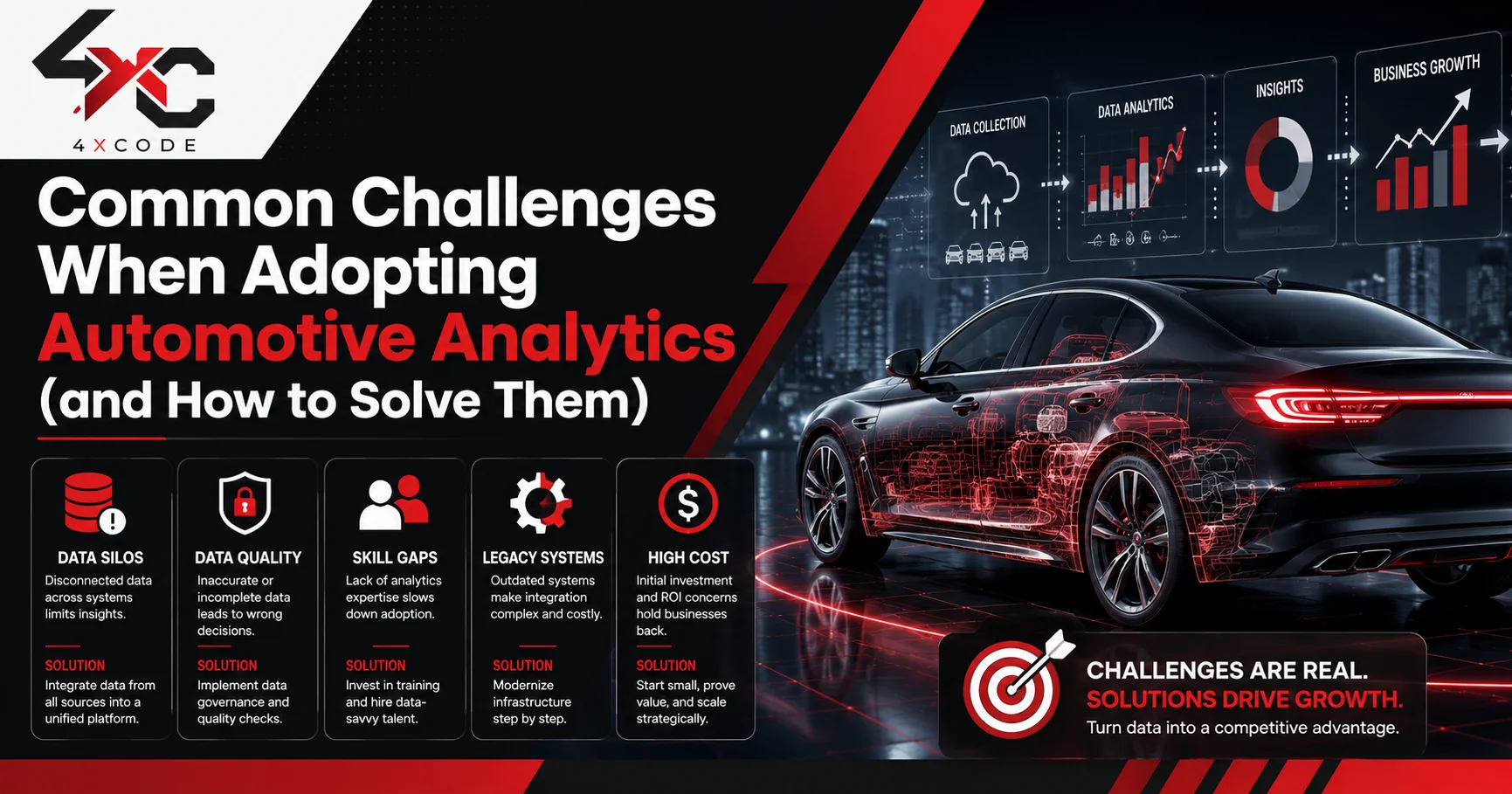
Analytics adoption isn't automatic. Most automotive businesses hit the same handful of obstacles.
Data Silos Between CRM, DMS, and ERP Systems
The most common problem isn't a lack of data, it's that the data lives in three or four disconnected systems that don't talk to each other. Sales data sits in the CRM, service history sits in the DMS, and financials sit in the ERP, with no unified view connecting them.
Solving this requires proper API integration and, in many cases, a data warehouse or data lake that consolidates these sources into a single reporting layer. Without that step, any analytics initiative will always be working from an incomplete picture.
Data Privacy & Compliance Risks (UK GDPR Considerations)
Automotive businesses handle sensitive customer data, financial details, location history via telematics, and personal identifiers tied to vehicle ownership. Under UK GDPR, this data has to be collected, stored, and processed with clear consent and defined retention rules.
This isn't just a legal checkbox. Customers are increasingly aware of how their data is used, and a business that handles it transparently builds more trust than one that treats privacy as an afterthought. Any analytics platform or vendor should be evaluated on its compliance posture as carefully as its reporting features.
Why Small and Independent Dealerships Struggle to Adopt Analytics
Larger dealer groups and OEMs often have dedicated data teams. Independent dealerships and smaller repair shops usually don't, and the assumption that analytics requires a large IT budget puts a lot of smaller businesses off even trying.
Is Automotive Analytics Affordable for Small Dealerships?
Yes, and increasingly so. Cloud-based analytics platforms have removed most of the infrastructure cost that used to make this the domain of large enterprises only. A small dealership doesn't need a data science team, it needs a platform that connects to its existing CRM and DMS and surfaces a handful of the right KPIs without requiring a SQL query to get there.
The real cost of not adopting analytics, lost sales from poor inventory decisions, customers lost to competitors who followed up faster, is usually far higher than the cost of a properly scoped analytics tool.
How to Choose the Right Automotive Analytics Platform (Getting Started)
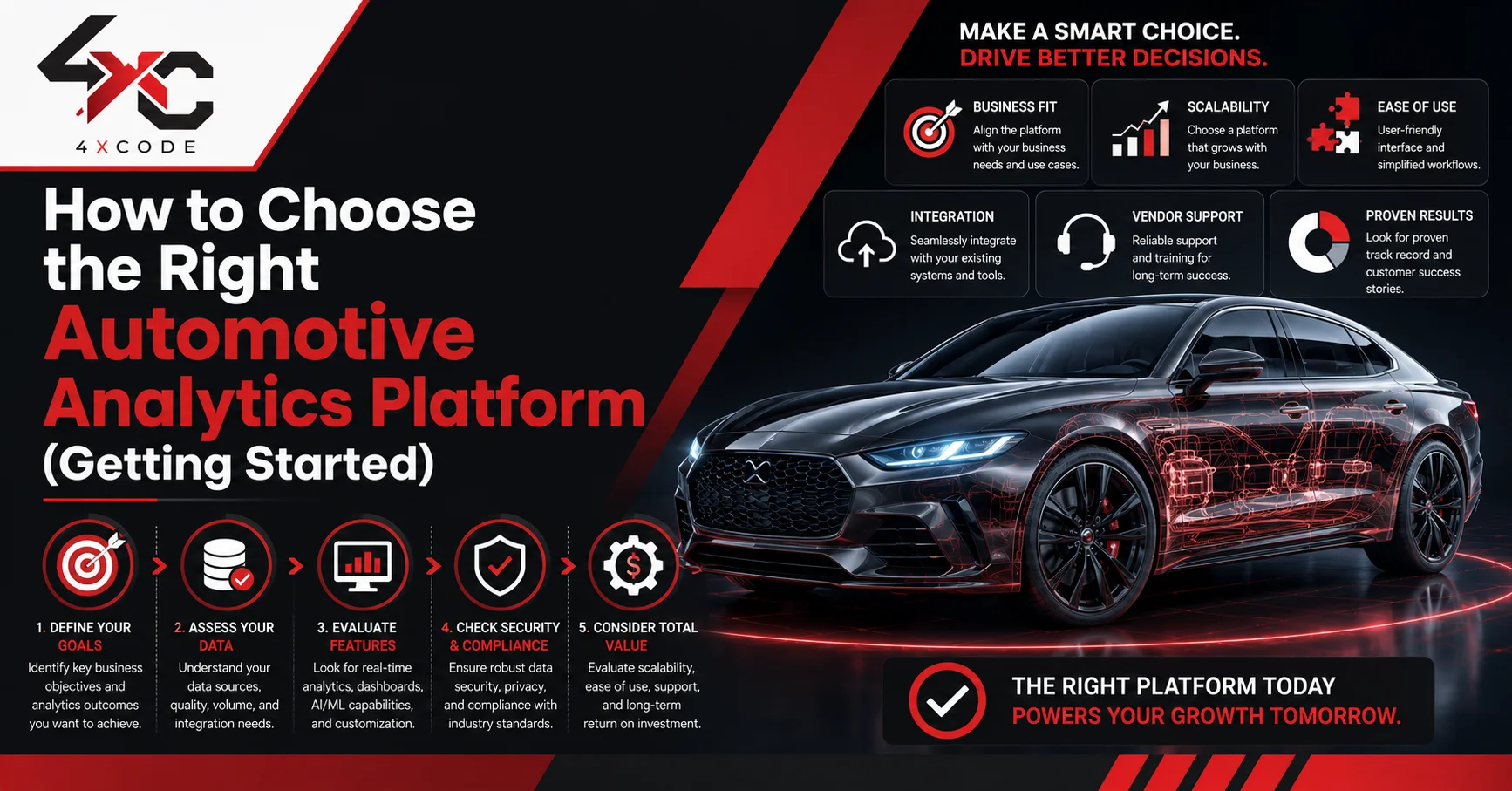
Once the case for analytics is clear, the next question is practical: which platform, and how do you get started without disrupting the business you're already running?
What to Look for in a Dealership Analytics Dashboard
A good automotive analytics dashboard should do a few things well, rather than everything badly. Look for:
- Native CRM and DMS integration the dashboard should pull data automatically, not require manual exports
- Real-time or near-real-time reporting monthly reports are too slow to act on
- Role-based views a sales manager and a service advisor need different dashboards, not the same one
- Predictive capability, not just historical reporting
- Clear data governance and security controls, especially given UK GDPR requirements
A platform that ticks these boxes turns analytics from a reporting exercise into an operational tool the team actually uses daily.
Build vs Buy: Should You Build Custom Analytics or Use a Ready Platform?
Factor | Custom-Built Analytics | Ready-Made Platform |
| Upfront cost | High, requires development time and ongoing maintenance | Lower, subscription or implementation-based pricing |
| Time to value | Months, sometimes longer | Weeks, in most cases |
| Flexibility | Fully tailored to specific workflows | Configurable, but within platform limits |
| Maintenance burden | Falls on internal IT/dev resources | Handled by the platform provider |
| Best suited for | Large OEMs with complex, unique data pipelines | Dealerships and mid-sized groups needing fast, reliable insight |
For most UK dealerships and dealer groups, a configurable ready-made platform delivers a faster return without the ongoing burden of maintaining custom software. Custom builds make more sense for large OEMs with highly specific integration needs across manufacturing, supply chain, and connected vehicle data at scale.
How 4xcode Helps UK Automotive Businesses Turn Data Into Growth
At 4xcode, we work with UK automotive businesses, from independent dealerships to multi-site dealer groups, to connect existing CRM, DMS, and inventory systems into a single, actionable analytics view. Rather than handing over a generic dashboard, we build reporting and forecasting around the KPIs that actually move revenue and retention for your specific business, with UK GDPR-compliant data handling built in from the start.
Book a Free Analytics Consultation With 4xcode
If you're not sure where your business stands, or which of the areas above would move the needle fastest, a short consultation is usually enough to map out a clear starting point. Get in touch with 4xcode to talk through your current data setup and where analytics could realistically take your business over the next 6–12 months.
Frequently Asked Questions
What is automotive data analytics? Automotive data analytics is the process of collecting and analysing data from across the vehicle and business lifecycle, sales, service, inventory, telematics, and customer interactions, to support better business decisions in areas like forecasting, retention, and operational efficiency.
How does data analytics improve dealerships? It improves dealerships by making inventory decisions more accurate, identifying customers likely to churn before they leave, forecasting demand more reliably, and reducing the manual reporting work that eats into staff time.
Why is data analytics important in the automotive industry? The automotive industry runs on thin margins, shifting demand (particularly with EV adoption), and increasingly digital-first customers. Analytics gives businesses the ability to react to these shifts with evidence rather than guesswork.
What KPIs matter most in automotive analytics? Inventory turnover rate, days-to-sale, customer acquisition cost, service bay utilisation, customer retention rate, and lead-to-sale conversion rate are among the most consistently valuable KPIs for dealerships and dealer groups.
How can predictive analytics reduce automotive costs? Predictive analytics flags maintenance issues, warranty risks, and demand shifts before they become expensive problems, reducing unplanned vehicle downtime, warranty claim volume, and overstocked inventory.
Is automotive analytics affordable for small dealerships? Yes. Cloud-based platforms have significantly lowered the cost of entry, meaning small and independent dealerships can access meaningful analytics capability without building an in-house data team.
Final Thoughts
Data analytics doesn't grow an automotive business on its own, but it removes the guesswork that quietly holds most of them back. The dealerships and dealer groups pulling ahead right now aren't necessarily the ones with the biggest budgets. They're the ones making faster, better-informed decisions about inventory, customers, and service, because they can actually see what's happening in their business in real time.
If you're ready to move from monthly spreadsheets to a system that shows you what's happening now, and what's likely to happen next 4xcode can help you get there without overhauling everything you already use.