
Your team exports the same report from three systems every Monday and pastes it into a spreadsheet that only one person fully understands. Orders are re-keyed by hand because the CRM and the accounts package don't talk to each other. The software you pay for each month does about 70% of what you need, and you work around the rest.
If that sounds familiar, you are probably weighing up a custom software development company in the UK. This page explains what a development partner builds, how a project runs, what drives the price, and how to judge whether a supplier deserves your trust. It is written for owners, operations heads and technical leads who want straight answers before they ask anyone for a quote.
At 4xCode, we build tailored applications, business systems and integrations for UK businesses. Whether you are replacing spreadsheets, connecting disconnected tools or modernising an ageing platform, you can discuss your project with us at any point. No commitment is needed to start the conversation.
What Does a Custom Software Development Company in the UK Build for Your Business?
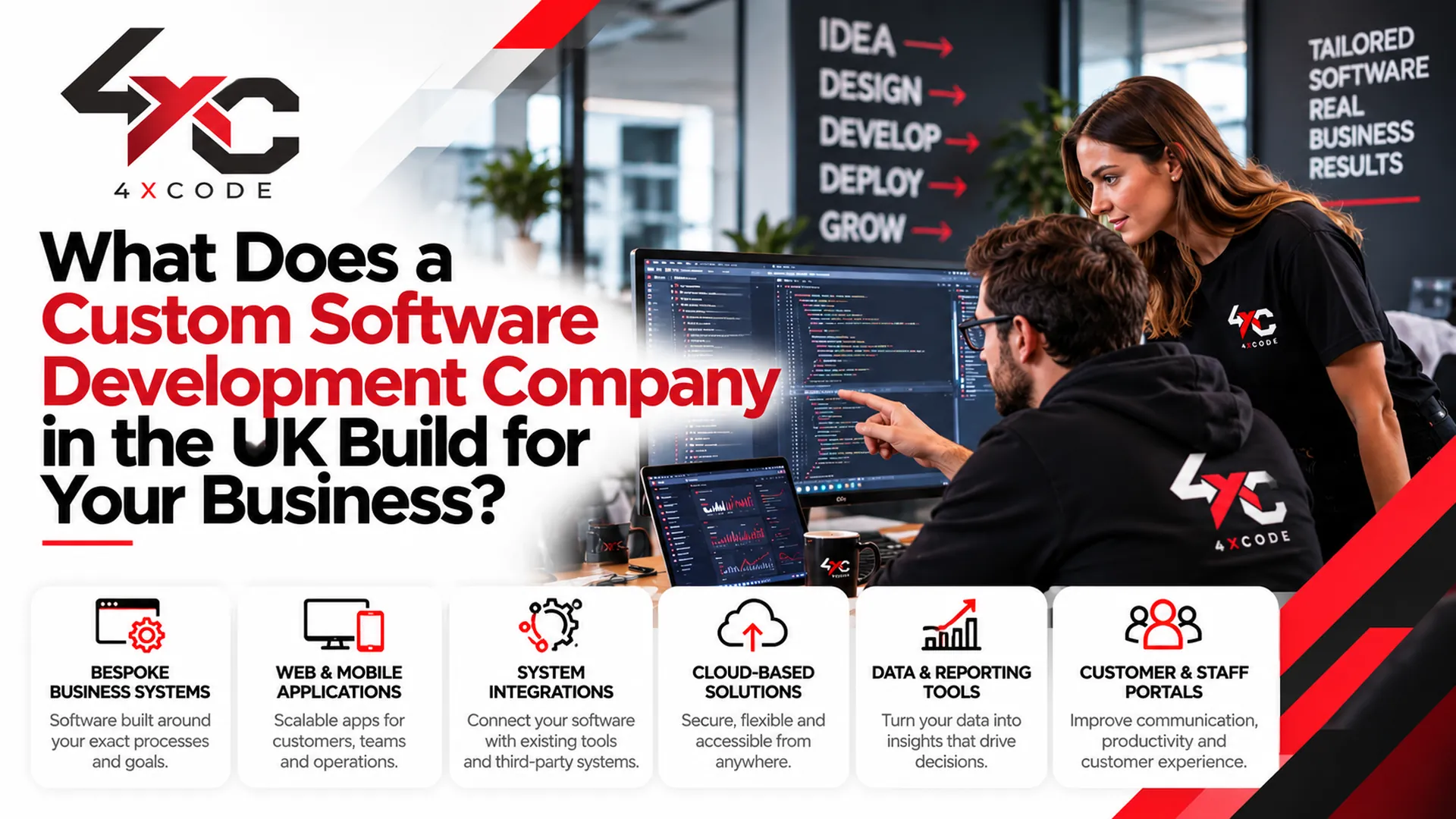
A custom software development company designs, builds, tests and supports software made for one organisation's specific processes, rather than for a mass market. The result is a system that fits your workflow, connects to the tools you already use, and can grow as the business does.
That is the short answer. The practical answer depends on the problem you are trying to solve.
Which Types of Bespoke Software Can a Custom Software Developer Build?
Most bespoke software projects fall into a handful of categories. Knowing which one you need makes your first conversation with any supplier far more productive.
- Custom web applications: browser-based systems your staff or customers use from any device, with no installation to manage.
- Internal business applications: tools for jobs, stock, scheduling, approvals or compliance records that generic software handles badly.
- CRM and ERP development: systems that mirror how you sell, buy and deliver, rather than forcing you into a vendor's data model.
- Customer and employee portals: secure areas for bookings, documents, orders, onboarding or self-service, with role-based access control.
- Workflow automation software: it takes over repetitive tasks such as approvals, notifications, data entry and document generation.
- Reporting dashboards: a single view of live data pulled from several sources, replacing the weekly spreadsheet exercise.
- API development and third-party integrations: the connective tissue that lets your CRM, accounting, payment and logistics systems share data reliably.
These are not separate worlds. A typical project mixes two or three. A booking platform, for example, might need a customer portal, an admin dashboard, an accounting integration and automated reminders.
A realistic scenario. A multi-location services business tracks jobs in a shared spreadsheet, invoices from a separate accounting package and answers customer queries from email. Nothing is wrong with any single tool. The cost is in the gaps: duplicate entry, late invoices and no live picture of what is happening. A custom job management system with accounting integration and a customer portal closes those gaps in one build.
The common thread is that custom software earns its place where your process is unusual, where several systems must work as one, or where the cost and limits of subscriptions are holding growth back.
Is Custom Software Better Than Off-the-Shelf Software for My Business?
Sometimes. Sometimes it is not, and a supplier who says otherwise is selling, not advising.
Off-the-shelf software is the right call when your needs are standard, such as payroll, basic bookkeeping or email marketing. It is quick to adopt, cheap to start and maintained by the vendor. Custom software becomes the better investment when your workflow is a competitive advantage, when you rely on several tools that don't integrate, or when licence costs scale painfully with headcount.
Factor | Custom software | Off-the-shelf software |
| Fit to your process | Built around your workflow | You adapt to the product |
| Upfront cost | Higher | Lower |
| Long-term cost | Predictable, no per-seat licence growth | Subscriptions rise as you grow |
| Integration | Designed around your existing systems | Limited to what the vendor supports |
| Time to start | Weeks to months | Immediate |
| Scalability | Planned for your growth path | Capped by the product's plans |
| Ownership | You can own the code and IP | You rent access |
| Best for | Complex, unusual or growth-critical needs | Standard, common business functions |
A useful rule of thumb: if you can describe the need in one sentence and a mainstream product already does it, buy. If you find yourself writing a long list of workarounds, build.
There is also a middle path. Many UK businesses keep their standard tools for commodity tasks and commission custom software only for the part that differentiates them, integrating the two through APIs. We will tell you plainly if that is the smarter route for you.
How Does Custom Software Development Work, and How Much Does It Cost in the UK?
Process and price are the two questions every buyer has, and the two most competitors skip. Here is how a well-run bespoke software development project works and what moves the cost.
What Happens at Each Stage of a Custom Software Development Project?
A sound project follows the software development lifecycle in clear stages, each with a visible output you can review.
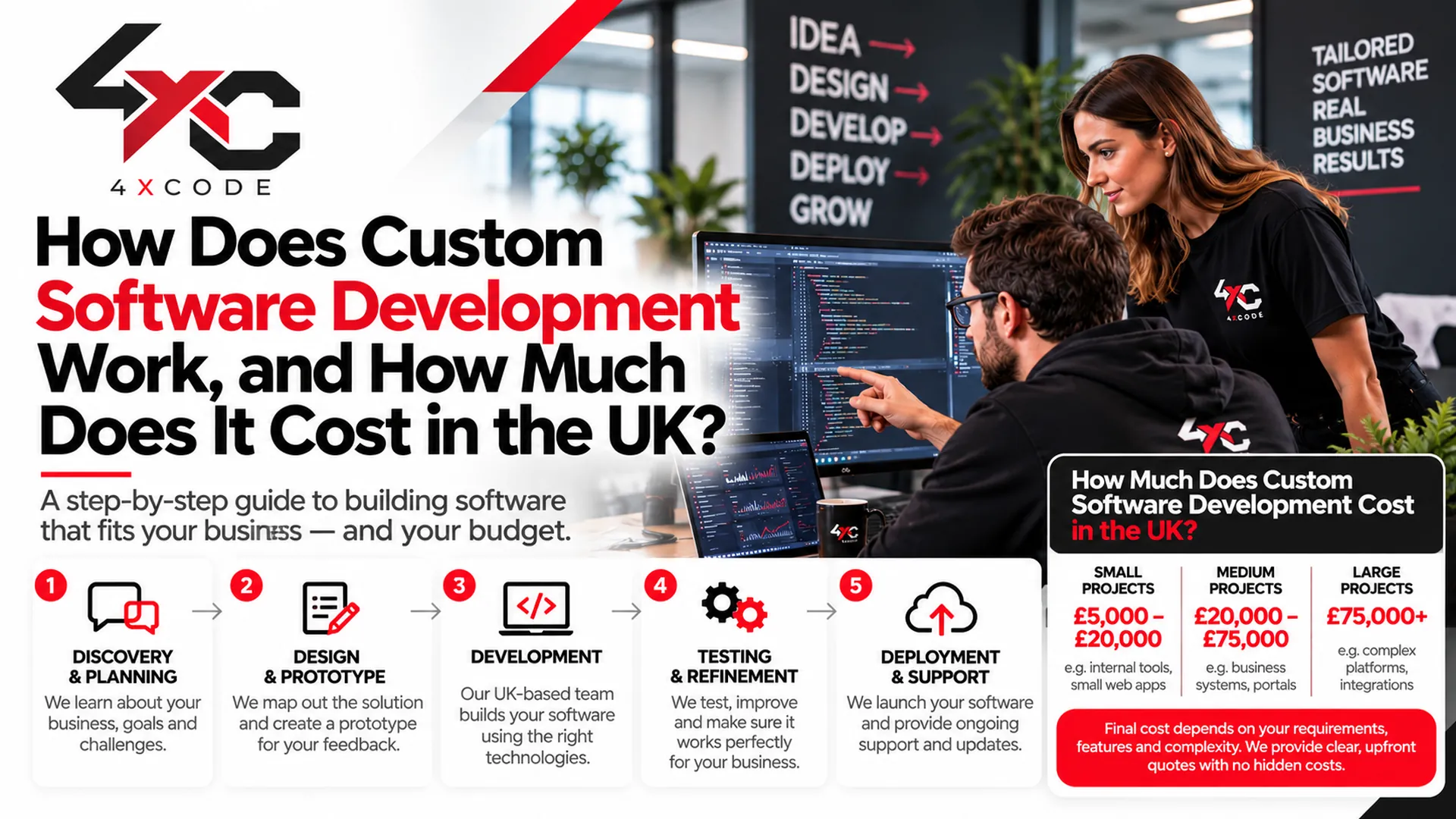
- Discovery and requirements gathering. We start with stakeholder interviews, a look at your current systems and a walkthrough of how work actually flows, which is often different from how people say it flows. The output is a clear scope with user stories and priorities.
- Software architecture and planning. We decide how the system is structured, how it connects to your existing tools, where it is hosted and how it will cope with growth. Security and data protection requirements are set here, not bolted on later.
- UX/UI design and prototyping. You see clickable screens before any code is written. It is far cheaper to change a prototype than a finished feature.
- Agile development in sprints. Work is delivered in short cycles, usually two weeks, with a sprint review at the end of each. You see working software early and steer it as you learn.
- Testing and quality assurance. Automated and manual testing, code review and user acceptance testing check that the software works under real conditions, including awkward ones.
- Deployment, training and handover. The system goes live through a controlled release, your team is trained, and documentation and knowledge transfer are completed.
- Post-launch support. Monitoring, fixes and improvements continue once real users are on the system.
What we need from you. The projects that go smoothly share one trait: a client who is available. Expect to provide access to the people who use the current process, quick feedback at each sprint review, and one person with authority to make decisions. Delays in decisions cost more than delays in code.
Common risks, and how they are handled. Scope creep, unclear requirements and integration surprises cause most project failures. Discovery reduces the first two. A technical review of the systems you need to connect to reduces the third, because undocumented or ageing APIs are a classic source of hidden effort.
What Affects the Cost of Bespoke Software Development in the UK?
There is no honest flat price for bespoke software, because no two projects are the same. What we can do is show you what moves the number, so you can judge any quote you receive, ours included.
The main cost drivers are:
- Scope and number of features: every additional user role, workflow or report adds design, build and testing effort.
- Integrations: connecting to a modern, well-documented API is straightforward. Connecting to a legacy system with poor documentation is not.
- Data migration: moving, cleaning and validating existing data, including a rollback plan, can be a project in itself.
- Security and compliance: applications handling personal data must respect UK GDPR and follow guidance from the Information Commissioner's Office. Higher-risk systems need deeper security testing, informed by sources such as the NCSC and OWASP.
- Design complexity: a simple internal tool costs less than a polished customer-facing platform.
- Testing depth: more critical systems need more extensive automated testing.
- Hosting and ongoing support: the build is only part of the total cost of ownership. Hosting, monitoring, maintenance and improvements continue after launch.
Because the build cost is only one part of the picture, ask every supplier for a view of the first-year running cost as well, not just the development quote.
How we estimate. After a discovery conversation we break the work into features, size each one and give you a written estimate with its assumptions spelled out. If something is unclear, we say so rather than burying it in a contingency line. Ready to see what your project would involve? Get a custom software quote and we will tell you what we would need to price it accurately.
Should You Choose a Fixed-Price or Time-and-Materials Software Project?
The right commercial model depends on how well defined the work is.
Fixed-price | Time and materials | |
| Best when | Scope is clear and unlikely to change | Requirements will evolve as you learn |
| Budget certainty | High, but changes are priced separately | Flexible, tracked against an agreed cap or forecast |
| Flexibility | Lower | Higher |
| Typical use | Defined internal tools, integrations, MVPs with a tight brief | New products, long-running platforms, continuous improvement |
| Main risk | Paying for change requests | Needs active budget oversight |
Many clients start with a fixed-price discovery phase, then move to a fixed-price build for the agreed scope or a time-and-materials arrangement for ongoing development. Whichever you prefer, you should always know what you are committing to before work begins.
How Do You Choose a Custom Software Development Company You Can Trust?
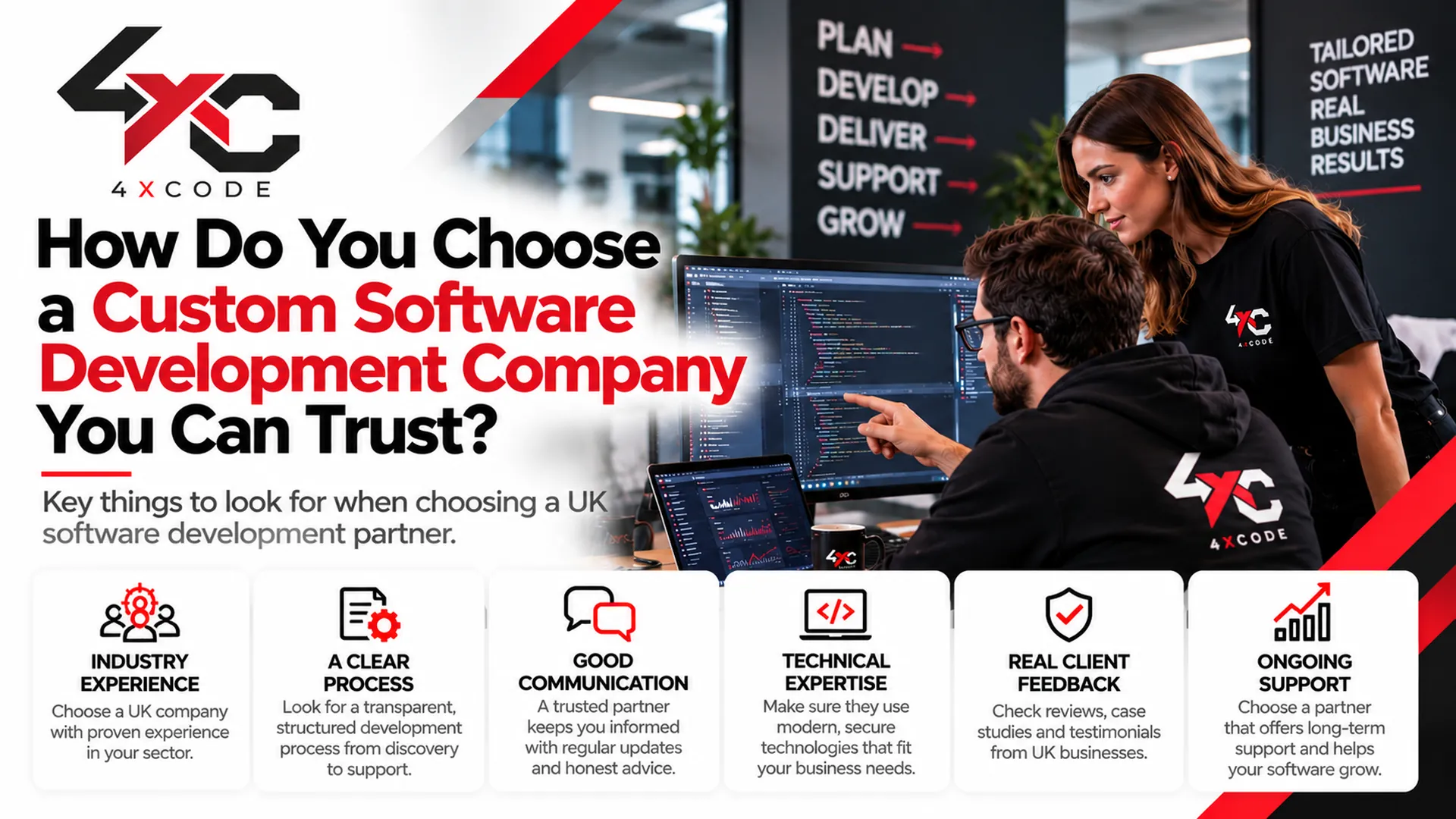
Choosing a partner is a bigger decision than choosing a price. You are trusting a team with your processes, your data and often your customer experience. Here is what to look for, and what to ask.
Evidence beats claims. Questions worth putting to any supplier, including us:
- Can you show relevant case studies with the original problem, the solution and the result?
- Who will actually work on my project, and can I speak to them before signing?
- How do you handle changes to scope, and who decides?
- What does your testing process look like, and how do you handle security?
- Who owns the code, and what happens if we part ways?
- What support do you provide after launch, and on what terms?
Be wary of suppliers who cannot answer these plainly, who give a price without asking questions, or who list dozens of technologies without showing where they have used them. A smaller UK team that answers directly is often a better bet than a large one that hides behind account managers.
Who Owns the Source Code, and What Support Do You Get After Launch?
This question matters more than most buyers realise until something goes wrong. Make sure the contract states clearly:
- Source code and intellectual property ownership: who owns the code and designs on completion, and what happens to reusable components.
- Handover: whether you receive the full repository, deployment instructions and technical documentation.
- Warranty period: how long defects found after launch are fixed at no extra charge.
- Maintenance and support: what is covered, such as bug fixes, security updates, monitoring and performance improvement, and what the response times are under any service-level agreement.
- Hosting and data: where your data lives, who has access and how backups and disaster recovery work.
- Exit terms: how you can move to another supplier or an in-house team without being locked in.
Agree these points in writing before the project starts. A good supplier welcomes the conversation, because clear terms protect both sides. If you want to see how we handle ownership, handover and support, ask us for our standard terms when you get in touch.
What happens when you enquire. You send a short summary of the problem. We reply promptly, usually to arrange a call. We then run a discovery or scoping conversation, and you receive a written proposal with scope, timeline, cost and terms. No pressure, and no obligation to proceed.
Frequently asked questions
How much does custom software development cost in the UK?
It depends on scope, integrations, data migration, security needs and support. A simple internal tool is a very different investment from a customer-facing platform connected to several systems. Reliable pricing comes from a scoping conversation, which is why we give written estimates with assumptions rather than a number from a rate card.
How long does custom software development take?
Small, well-defined tools can be delivered in a matter of weeks. Larger platforms with integrations and data migration take several months. Working in sprints means you see usable software early and do not have to wait for a single launch date.
What is the difference between bespoke and off-the-shelf software?
Bespoke software is built for your processes and owned or controlled by you. Off-the-shelf software is built for a broad market, so you adapt your work to fit it. Bespoke costs more upfront but can cost less over time and fits better. Off-the-shelf is faster and cheaper to start.
How do I choose a custom software development company?
Look for relevant case studies, named people you can speak to, clear answers on testing, security, ownership and support, and a proposal that explains its assumptions. Ask for references and check that what they claim can be verified.
Who owns the software after it has been developed?
This is set by the contract. It is normal to expect ownership of the bespoke code and intellectual property to transfer to you on payment, but always confirm this in writing, along with documentation and handover terms.
Can custom software integrate with existing business systems?
Yes. Custom software is often built specifically to connect CRM, ERP, accounting and other tools through APIs, so data flows without re-keying. The effort depends on the quality of the systems it needs to connect to.
How is my data protected?
Through secure development practices, access controls, encryption, tested backups and compliance with UK GDPR. Security is planned from the architecture stage rather than added at the end.
Ready to Talk About Your Software Project?
Good custom software removes friction from a business. It replaces the spreadsheet workarounds, joins up the systems that should have been talking all along, and gives you a platform that grows without a licence bill that grows with it.
You do not need a perfect brief to start. A paragraph describing what is slowing your business down is enough. From there, we will tell you honestly whether custom software, packaged software or a mix of both is the right route. Read more guides on our blog.
Discuss your project with 4xCode or request a custom software quote today, and we will come back with clear next steps.