
Your team exports a spreadsheet, pastes it into another system, fixes the mismatches by hand, and emails the result to someone who re-enters half of it. Everyone knows the process is slow. Nobody has time to fix it, and no off-the-shelf product fits quite right.
That gap between how your business works and how your software works is where bespoke software development in the UK earns its keep. At 4xCode, a remote-first software company founded in 2021 with its UK base in Romford, London, we design and build custom business software that fits your processes, not the other way round.
This guide explains what bespoke software is, how a project runs, what drives the cost, who owns the code afterwards, and how to judge any bespoke software development company in the UK before you sign. If you'd rather talk it through, you can book an intro call at any point.
What Is Bespoke Software Development, and When Does a UK Business Need It?
Bespoke software development is the process of designing, building, and maintaining a software system around one organisation's specific workflows, data, and users. It is also called custom software development, and in practice the two terms mean the same thing. The software is purpose-built for your business rather than licensed as a general product.
Most businesses start with off-the-shelf tools, and that is the right call early on. The trouble begins when the business grows around the software instead of with it.
You probably need custom business software if you recognise several of these:
- Spreadsheets run critical processes. Quoting, scheduling, or stock tracking lives in files that only one person fully understands.
- Staff re-key the same data. Duplicate data entry between systems wastes hours and introduces errors.
- Your systems don't talk to each other. The CRM, accounting package, and booking tool each hold part of the picture, and nobody sees all of it.
- Subscriptions keep stacking up. Per-user licence fees climb every time you hire.
- You work around the software. Staff invent manual workarounds because the tool can't handle an exception that happens weekly.
- Reporting is slow or unreliable. Managers wait days for figures they should see live.
Two or three of those signs usually mean the cost of staying put is already higher than the cost of building something better. Fixing the process first is sometimes enough, which is why a good supplier will ask questions before suggesting a build.
Should You Build Bespoke Software or Buy Off-the-Shelf?
Neither option wins every time. The right answer depends on how unusual your process is and how much of your competitive edge sits inside it.
Factor | Off-the-shelf / SaaS | Bespoke software |
| Upfront cost | Low | Higher |
| Cost over 3-5 years | Rises with users, tiers, and add-ons | Often flatter once built, plus hosting and support |
| Fit to your workflow | You adapt to the product | The product adapts to you |
| Speed to start | Immediate | Weeks to months |
| Flexibility | Limited to vendor roadmap | Changes follow your priorities |
| Ownership | Licence only | Depends on contract; can include full code ownership |
| Vendor lock-in | Common | Lower, if handover terms are clear |
| Integrations | Limited to what the vendor supports | Built to your exact systems |
When off-the-shelf is the better choice: your process is standard, such as payroll, basic email marketing, or generic accounting. A well-known product has years of testing behind it, and you shouldn't pay to rebuild it.
When bespoke wins: your process is what makes you different, your tools can't connect, or licensing costs are growing faster than your revenue.
There is also a middle path. Many projects keep a trusted SaaS tool for commodity functions and build custom software around it for the parts that matter, connected through APIs. We often recommend this hybrid route because it limits risk and budget. We'll tell you if you don't need us.
Which Business Systems Can a UK Bespoke Software Company Build?
"Bespoke" covers a wide range. These are the categories we see most often, and each connects to a service we deliver:
- Internal business tools and job management systems. These handle quotes, work orders, scheduling, invoicing, and reporting in one place. Our web development service covers these full-stack builds.
- Customer, supplier, and employee portals. Secure logins with role-based access control mean each user sees only what they should.
- Booking and appointment systems. These suit service firms, clinics, hospitality, and field teams.
- CRM and ERP applications and integrations. You can build a lightweight bespoke CRM, or connect your existing CRM, ERP, accounting software, and payment gateways so data flows once instead of three times.
- Mobile applications. We build for iOS and Android using React Native, Swift, and Kotlin through our mobile app development service.
- SaaS platforms and MVPs. If you're launching a product, our SaaS engineering work covers multi-tenant architecture, billing, authentication, and dashboards.
A typical scenario: a 30-person service business quotes jobs in spreadsheets, schedules engineers on a shared calendar, and invoices from a separate accounting package. A bespoke job management system can bring the quote, the visit, the paperwork, and the invoice into one workflow, with the accounting package kept and connected rather than replaced. Nothing gets re-typed, and managers see work in progress without chasing anyone.
How Does Bespoke Software Development Work, and What Does It Cost in the UK?
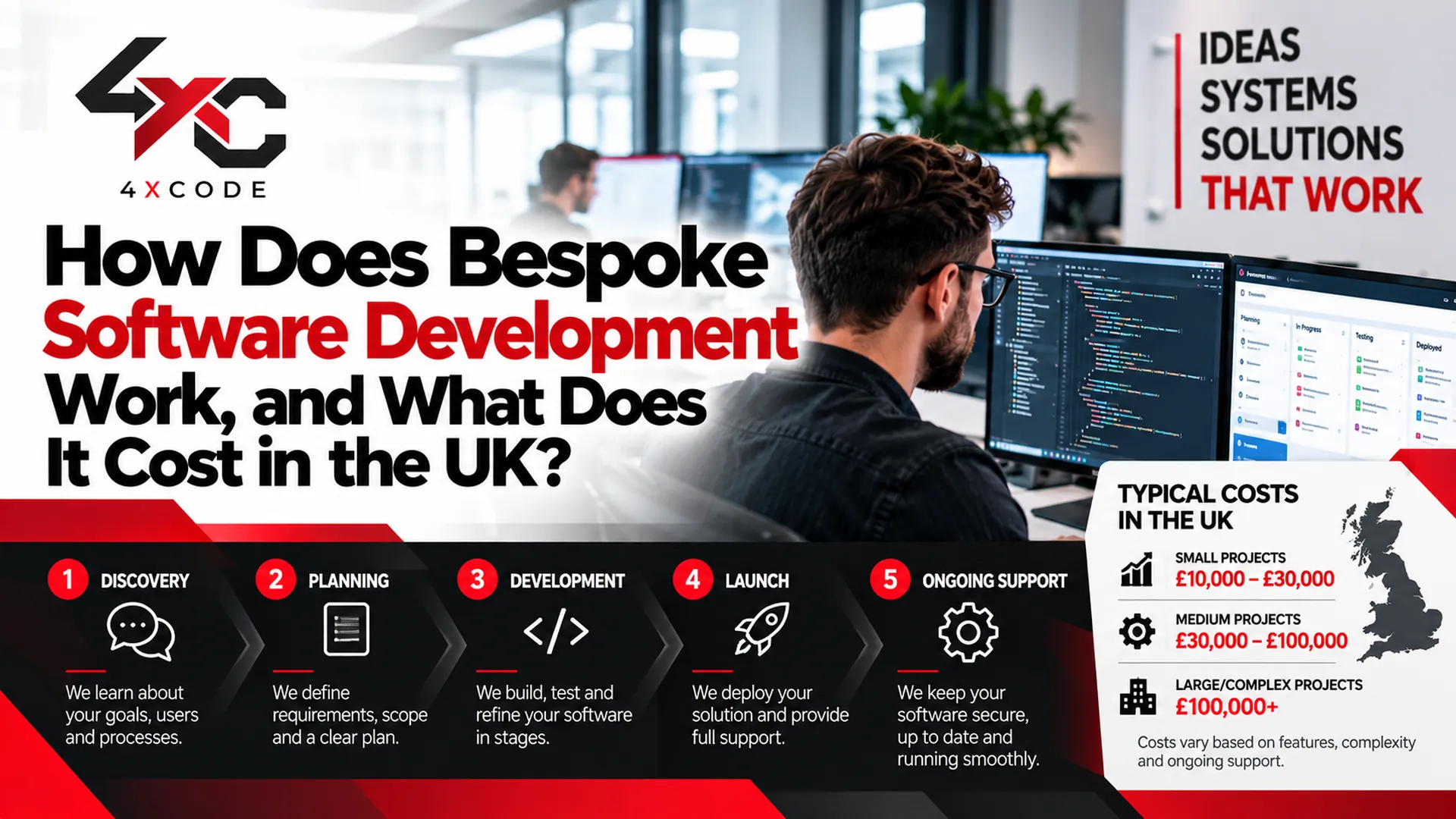
A well-run project follows a clear sequence, and the cost follows from decisions made in that sequence. In short, you define the problem, design the solution, build it in visible increments, launch it, and keep improving it. Cost depends mainly on scope, integrations, data complexity, and support needs, and a fixed quote is only trustworthy after a proper discovery phase.
What Are the Stages of a Bespoke Software Project, Step by Step?
Here is how our five stages work in practice, including what you receive and what we need from you.
1. Discover. We run workshops with the people who use the current process, review any existing systems, and carry out a technical audit. You receive a written scope, a prioritised feature list, and a product roadmap. We need access to your team and honest information about how work really happens, including the messy parts.
2. Design. Before any code is written, we produce UX flows, wireframes, and interactive prototypes. You click through the proposed system and correct it while changes are still cheap. We need decisions from your stakeholders, because indecision at this stage is the most common cause of delay later. Our UI/UX design service covers this work, including accessibility for business applications.
3. Development. Our engineers build in an agile way, in short cycles, and you see weekly progress updates and working releases rather than a long silence followed by a big reveal. This is also where integrations happen. We connect your new system to existing platforms through APIs, map data between systems, handle errors and synchronisation, and migrate legacy data with validation and reconciliation checks. Where an old system can't be switched off overnight, we plan a phased cutover with a rollback option.
4. Launch and scale. Testing comes first: quality assurance, user acceptance testing with your own staff, and performance checks. Then we deploy to cloud hosting, set up monitoring and backups, and release. Our cloud systems work covers infrastructure on AWS, Vercel, and Cloudflare.
5. Optimise and evolve. Real usage data tells you what to change. We review analytics and user feedback, fix bugs, apply security patches, and plan the next features.
How Much Does Bespoke Software Development Cost in the UK?
Cost varies widely because "bespoke software" ranges from a small internal tool to a multi-user platform with dozens of integrations. Any supplier quoting a price without understanding your scope is guessing. These are the factors that move the number:
Cost driver | Why it matters |
| Scope and number of features | More screens, rules, and reports mean more design and build time |
| Integrations | Each connection to a CRM, ERP, accounting tool, or payment gateway needs mapping, testing, and error handling |
| User roles and permissions | Complex access control adds logic and testing |
| Data migration | Cleaning and moving legacy data is often underestimated |
| Security and compliance needs | Sensitive data, audit trails, and UK GDPR obligations add work |
| Platforms | A web application costs less than web plus iOS and Android |
| Testing depth | Business-critical systems justify more thorough test coverage |
| Ongoing support | Hosting, maintenance, and enhancements continue after launch |
Pricing models, explained plainly:
- Fixed price suits well-defined scope. You know the cost in advance, and changes go through a change request.
- Day rate or time-and-materials suits evolving requirements, with flexibility in exchange for less certainty on the final total.
- Retainer suits continuing development and support after launch.
What a good quote includes: a clear scope, deliverables per milestone, assumptions, what counts as a change, hosting and maintenance costs, and who owns what at handover. If a quote is a single line with a single number, ask for the details.
4xCode pricing: Whatever the number, remember total cost of ownership: licence fees you stop paying, hours you stop losing, and running costs you take on.
How Long Does a Bespoke Software Project Take?
Timelines depend on scope and how quickly decisions are made, but these ranges are realistic:
Project type | Typical timeframe |
| Focused MVP or internal tool | Several weeks |
| Multi-user business system with a few integrations | A few months |
| Larger platform with legacy migration | Several months, often delivered in phases |
Some of our clients have reported MVPs delivered in six weeks and a move from discovery to launch in under two months. Those projects had tightly defined scope and fast feedback loops, so treat them as best cases rather than promises. The fastest route is a short discovery, a narrow first release, and then expansion based on real usage.
Why Choose 4xCode as Your UK Bespoke Software Development Company?

Plenty of agencies claim experience. You should be able to check it. Here's what we can point to.
Our track record in numbers:
- Founded in 2021, remote-first, with a UK base in Romford, London
- 132+ products shipped across web, mobile, and SaaS
- 99.99% production uptime across the platforms we run
- 9 years average experience across our senior engineering team
- A reply within 24 hours to every project enquiry, with a clear opinion on the path forward
A real example: Vogue Technics. Vogue Technics has been a trusted UK automotive repair garage for over two decades, covering servicing, MOT support, engine rebuilds, and advanced diagnostics. Like many established workshops, it ran on manual processes. We helped move the business from manual garage operations to a fully digital system. Read the full case study for the problem, the approach, and the outcome. You can also browse more of our work, including projects for a luxury transportation business and an engine replacement specialist.
How to evaluate any bespoke software company, including us:
- Ask for case studies with specifics. Look for the original problem, what was built, and measurable results.
- Ask who will do the work. Senior engineers or a rotating junior team?
- Ask how scope changes are handled. Vague answers usually mean budget surprises later.
- Ask about ownership and exit terms before the contract, not after.
- Ask for references you can contact.
- Watch for warning signs. Pressure to sign quickly, no discovery phase, and a fixed price offered without any questions are all red flags.
Who Owns the Source Code, and How Is Your Data Protected Under UK GDPR?
These two questions decide whether a project helps you for years or traps you.
Source code and IP ownership. The contract should state who owns the code and intellectual property, and what you receive at handover: source code repository access, technical documentation, hosting credentials, and data exports. Ask what happens if the supplier is unavailable, because another team should be able to take over your system without starting again. This is how you avoid vendor lock-in.
Security and data protection. Good practice covers authentication and role-based access control, encryption, regular backups, and security testing before release. If your software processes personal data, UK GDPR and the Data Protection Act 2018 apply, and the Information Commissioner's Office (ICO) is the regulator. Be careful with how suppliers describe this: building software that supports compliance is different from a supplier being certified. Ask for specifics, including a data processing agreement where it applies.
Support and maintenance. Launch is the start, not the finish. Support agreements should cover bug fixes, security patches, upgrades, monitoring, and a clear service level for response times. Ask what's included and what's charged separately.
Frequently Asked Questions About Bespoke Software Development
What is the difference between bespoke and custom software?
In most cases, nothing. The terms are used interchangeably in the UK. Both describe software designed and built for one organisation's specific needs, as opposed to a packaged product sold to many.
Is bespoke software suitable for small businesses?
Yes, when the problem justifies it. A small business with a costly manual process, a spreadsheet that has outgrown its purpose, or several tools that don't connect can see a clear return from a focused internal tool. Starting small, with one process and one release, keeps the budget under control.
Can bespoke software integrate with my existing systems?
Yes. Bespoke systems are commonly built to connect with CRM, ERP, accounting software, payment gateways, and legacy databases through APIs. The quality of the integration depends on how well the data is mapped and how errors are handled, so ask how a supplier approaches both.
Can legacy software be modernised without replacing everything?
Often, yes. A phased approach moves one module or data set at a time, keeps the business running throughout, and avoids a risky all-at-once switch. A discovery phase should show whether modernising or replacing is the better option.
Who owns the code in a bespoke software project?
It depends entirely on the contract. Many clients expect to own the code, but some suppliers retain it or license it. Settle this in writing before work starts, along with documentation and credentials at handover.
What if I don't know exactly what I want at the start?
That's normal, and it's what discovery is for. Workshops, prototypes, and a prioritised roadmap turn a vague problem into a clear scope before you commit to a build.
Can I add features after launch?
Yes. Well-built software is structured to grow, and many of our clients release in phases, adding features as usage shows what matters most.
How do I calculate the return on bespoke software?
Add up the costs you remove: licence fees you stop paying, staff hours spent on manual work, and errors that cost money. Compare that total with the build cost plus ongoing hosting and support over three to five years. The result gives you a payback period, and it also shows whether the project is worth doing at all.
Is a UK-based development team worth it?
For many businesses, yes. A UK team works in your time zone, understands UK business and data protection requirements, and is easier to meet in person when the project needs it. Whatever location you choose, judge the team on delivery evidence and communication, not postcode alone.
Ready to Fix the Process That's Costing You Time?
The best bespoke software projects start with a conversation about the problem, not a sales pitch about the solution. Tell us what's slowing your business down, and we'll come back within 24 hours with a straight opinion: whether bespoke software is the right move, what a sensible first release looks like, and what it would involve.